Forums › Forums › Fungi ID requests (post here if you aren’t sure what type of fungus you’ve found) › Could this be a Russula…
- This topic is empty.
-
AuthorPosts
-
February 25, 2023 at 8:34 pm #32565
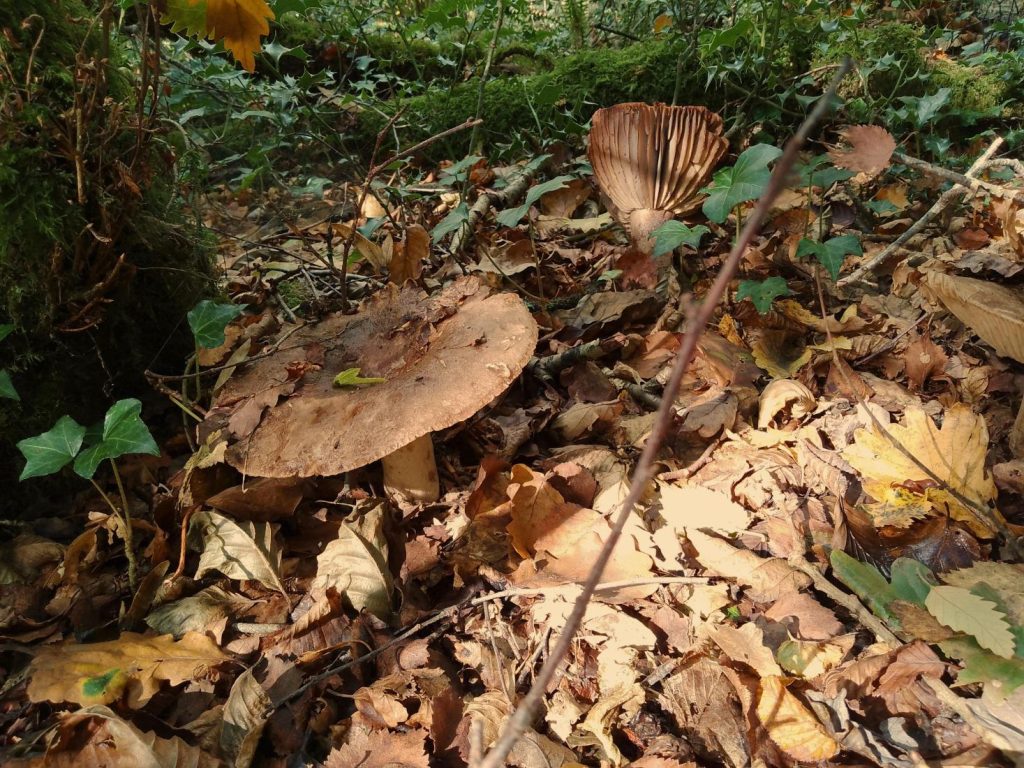
Hi everyone, Photo taken last Oct, mixed deciduous woodland, in leaf litter. In group.
Cap; Large approx. 10cm – 15mm. Dirty fawn grey, becoming deeply funnel shaped. Gills; pale pink/tan going to grey, adnate/sinuate and robust, not esp. crowded, short gills near cap edge, possibly blackening on gill edges. Stem; Sturdy, off white/fawn, possibly attenuated at base. No sign of “milk”. These lasted a long time, just getting darker, dingier and blackening, (no sign of any red colouration), rather than disintegrating quickly.
[attachment=2]10ci.jpg[/attachment] 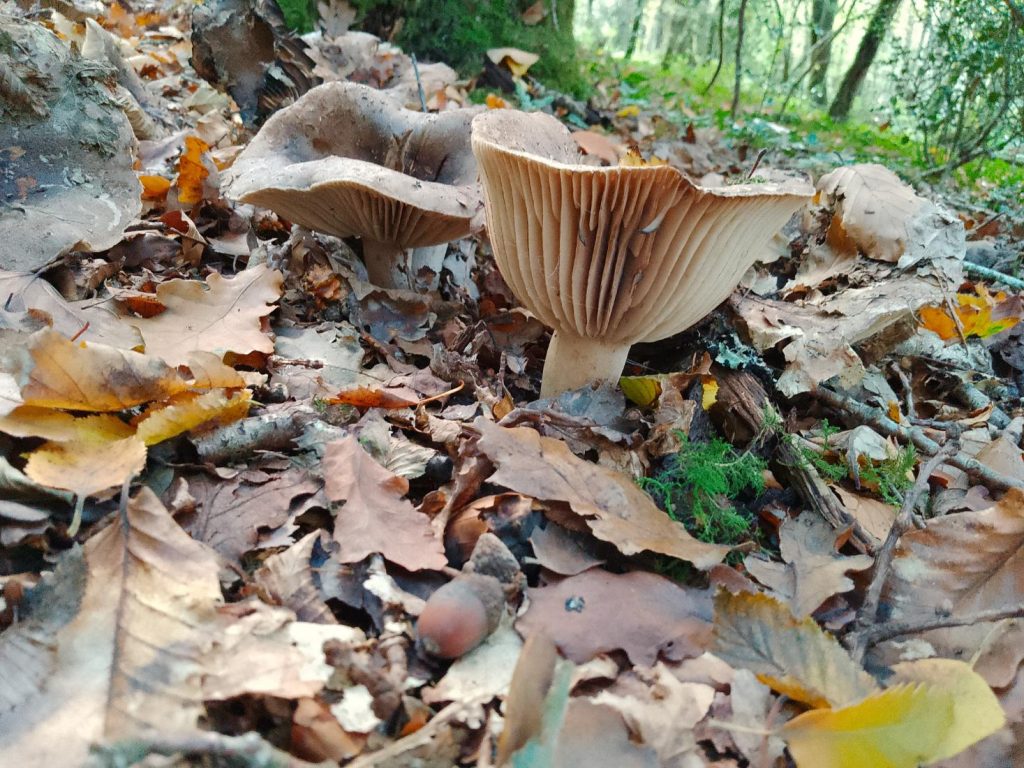
[attachment=1]10ai.jpg[/attachment] 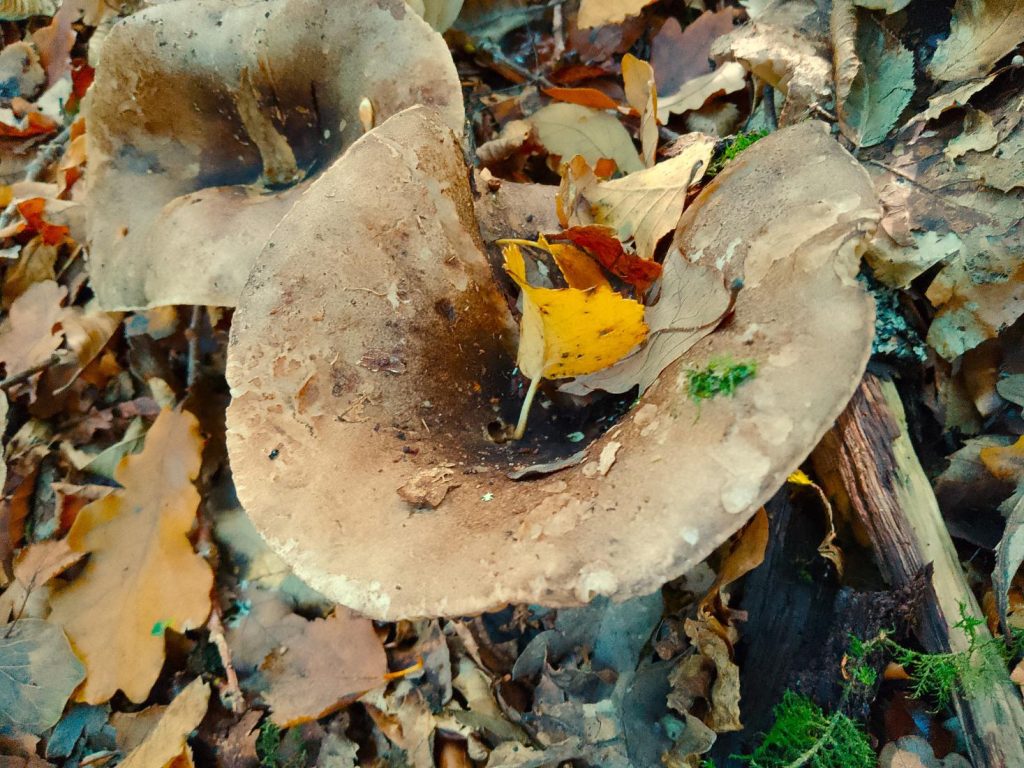
[attachment=0]10bi.jpg[/attachment] Any help much appreciated,
Ali
February 26, 2023 at 11:12 am #45318Hi, Yes – Russula.
These have the typical looks of quite fresh “Blackening Russula” –
Russula nigricans. Given a few more days they would have gone completely black.
Then, over a quite considerable timescale, (in comparison with most mushrooms), generally becoming quite “limp” and “soggy”, exhibiting a rotting fish sort of smell as they gradually decompose.
At that decomposing stage, it’s always worth checking them out for the two species of “Piggyback Mushroom”: –
Asterophora parasitica– (Silky Piggyback), and Asterophora lycoperdoides– (Powdery Piggyback), which can often be found growing on them. ( See: –
https://www.fungi.org.uk/viewtopic.php?p=10291#p10291 Regards,
Mike.
February 26, 2023 at 8:21 pm #45319Thanks Mike. I was also looking at R. densifolia and R. anthracina last night in Pat O’Reilly’s book. I’m not sure if I can tell the difference between the three of them just on my photos. They all seem to be common. He mentioned that R densifolia has intermittent “short” gills near cap margin, which mine has. Neither do mine have an “inrolled” margin, although that may have grown out. Also, there was no sign of reddening on any damaged bits. They just seemed to get blacker. Does any of this help to rule any of the 3 Russula in/out?
Ali
February 27, 2023 at 5:40 pm #45320Hi, I would be expecting both
R.densifoliaand R.anthracinato have more closely spaced gills than those on your examples. – But that characteristic alone wouldn’t be sufficient for a certain identification. – It shows yet again just how difficult it is to try to identify fungi to species level when only photos and very little else of the relevant information is available. I’ve copied below Geoffrey Kibby’s excellent key to Blackening Species of Russula, Section Compactae – from Field Mycology Journal Vol.2 Issue 3, to give you some idea of the required information.
NB: The key has references to various illustrative figures etc. which are included in the original Field Mycology Journal article – but I can’t copy the entire article here: –
Abbreviations used in the key:
RR = Rayner, R.W. (1985). Keys to the British Species of Russula, third edition. British Mycological Society.
RP = Phillips, R. (1981). Mushrooms and other fungi of Great Britain & Europe. Pan Books
CD = Courtecuisse, R. & Duhem, B. (1995). Mushrooms & Toadstools of Britain & Europe. Harper Collins.
SBA = sulfobenzaldehyde.
SV = sulfovanillin.
1. Flesh turning red before becoming grey to black . . . . . . . . . . . . . . . . . . . . . . . . . . . . . . . . . . .2
– Flesh turning directly grey to black . . . . . . . . . . . . . . . . . . . . . . . . . . . . . . . . . . . . . . . . . . . . 6
2. Taste mild in the flesh and mild to occasionally slightly acrid in the lamellae . . . . . . . . . . . . . . . .3
– Taste somewhat acrid in flesh and very acrid in the lamellae . . . . . . . . . . . . . . . . . . . . . . . . . . . 5
3. Lamellae thick and very widely spaced (4-6 per cm); fruit bodies sturdy and fleshy; flesh strongly reddening before blackening; common everywhere under conifers and broad-leafed trees . . . . . . . . .. . . . . . . . . . . . . . . . . . . . . . . . . . . . . . . . . . RR3, RP92, CD1345
R. nigricans– Lamellae closer spaced to very crowded (9-14 per cm); fruit bodies large to small; flesh turns pink to red before blackening; under conifers or broad-leafed trees on acid soils . . . . . 4
4. Fruit bodies often very large (12+ cm); cap cuticle with long, septate, cylindrical cells (fig. 1); flesh pale pink then grey; odour faint, sour, of wine barrels; under pines on sandy soils, uncommon . . . . .. . . . . . . . . . . . . . . . . . . . . . . . . . . . . . . . . . . RR5, RP91, CD1348
R.adusta– Fruit bodies small to medium; cap cuticle with cells often very broad, swollen-ovate (fig. 2); flesh red then grey-black; odour indistinct; conifers or broad-leafed trees, seemingly uncommon . . . . . . . . . . . . . . . . . . (non sensu Rayner, Roger Phillips), CD1349
R. densifolia5. Flesh only very slightly reddening; cap cuticle without pileocystidia, but with cells showing abundant large blackish droplets internally (fig. 3); lamellae often with a pinkish-flesh tint; flesh slightly acrid but noticeably acrid in the lamellae; common in broad-leafed woods . . . . . . . . .. . . . . . . . . . RR6, RP91 (both as
R. albonigra), CD1347 R. anthracina– Flesh strongly reddening; cap cuticle with pileocystidia, often numerous and frequently diverticulate at tips (fig. 4), not reacting in SV, but contents granular, greyish in SBA; lamellae pale cream; flesh slightly acrid, extremely acrid in lamellae; infrequent (?) in broadleafed woods . . . . . . . . . . . . . . . . . .. RR4,RP93 (both as
R. densifolia), R. acrifolia6. Lamellae medium spaced (4-8 per cm), distinct refreshing menthol taste in gills; flesh rapidly blackening; pileocystidia rather large, never forked at tip, with oil drops not blackening in SBA or SV; on calcareous soils . . . . . . .. . ( non sensu Rayner, Roger Phillips), CD1346
R. albonigra– Lamellae more crowded (10-14 per cm); taste mild and menthol-like to rather acrid; flesh blackening to blackish-brown; pileocystidia absent or if present hard to distinguish, but cells with large black oil droplets may be visible when mounted in SVA or SB . . . . . . . . . . . . . . . . . . . . . . . . . 7
7 Taste mild and slightly menthol-like in lamellae; pileocystidia absent; Mediterranean under holm oak and turkey oak (Quercus ilex,Q.cerris) . . . . . . . . . . . . . . . . . . . . . .
R.atramentosa* – Taste noticeably acrid in flesh or lamellae; pileocystidia present or absent . . . . . . . . . . . . . . . . . . 8
8. Pileocystidia present but often hard to distinguish, narrow, many with diverticulate ends, with small blackish oil drops in SBA; lamellae always white, found with oaks. Recently described by Sarnari, might occur in Britain . . . . . . . . . . . . . . . . . . . . . . . . . . .
R. fuliginosa* – Pileocystidia absent, many cells showing abundant large blackish droplets internally (fig. 3);
lamellae often with a pinkish-flesh tint (sometimes distinguished as var. carneifolia); common in broad-leaf woods . . . . RR6, RP91 (both as
R. albonigra), CD1347 R. anthracinaI’d still be inclined towards
R.nigricanswith the gill spacings visible on your examples – but to be properly certain, the microscopy would need to be done. Regards,
Mike.
February 27, 2023 at 6:40 pm #45321Hi Mike, Thank you so much for taking the time to post all that info. I think I will be buying Geof Kibby’s latest book.
Much of it is beyond my expertise, at the moment (!), but I’ve looked hard at Roger Phillips and agree R nigricans is the most likely, with a ? (In green, on my list!). If it comes back this year I will endeavour to look a bit more carefully and have copied/pasted the info.
Ali
-
AuthorPosts


- You must be logged in to reply to this topic.