- This topic is empty.
-
AuthorPosts
-
March 9, 2020 at 3:17 pm #31609
Dear users of the UK Fungi forums, This is my first post here, so let me briefly introduce myself: I am a student of biology at Aarhus University, Denmark, and over the past 4-5 years, I have developed a burning passion for lichens. Two years ago I bought my first microscope and since then my passion has only intensified – culminating recently in my master’s thesis on the influence of microclimate on species composition in arctic tundra (a work in progress). I feel most at home in Parmeliaceae and Physciaceae, but I am working on expanding my “home turf”

I still struggle with many of the crustose spp., but this, it seems, is not unique to my situation.
Take this Athallia, for instance.
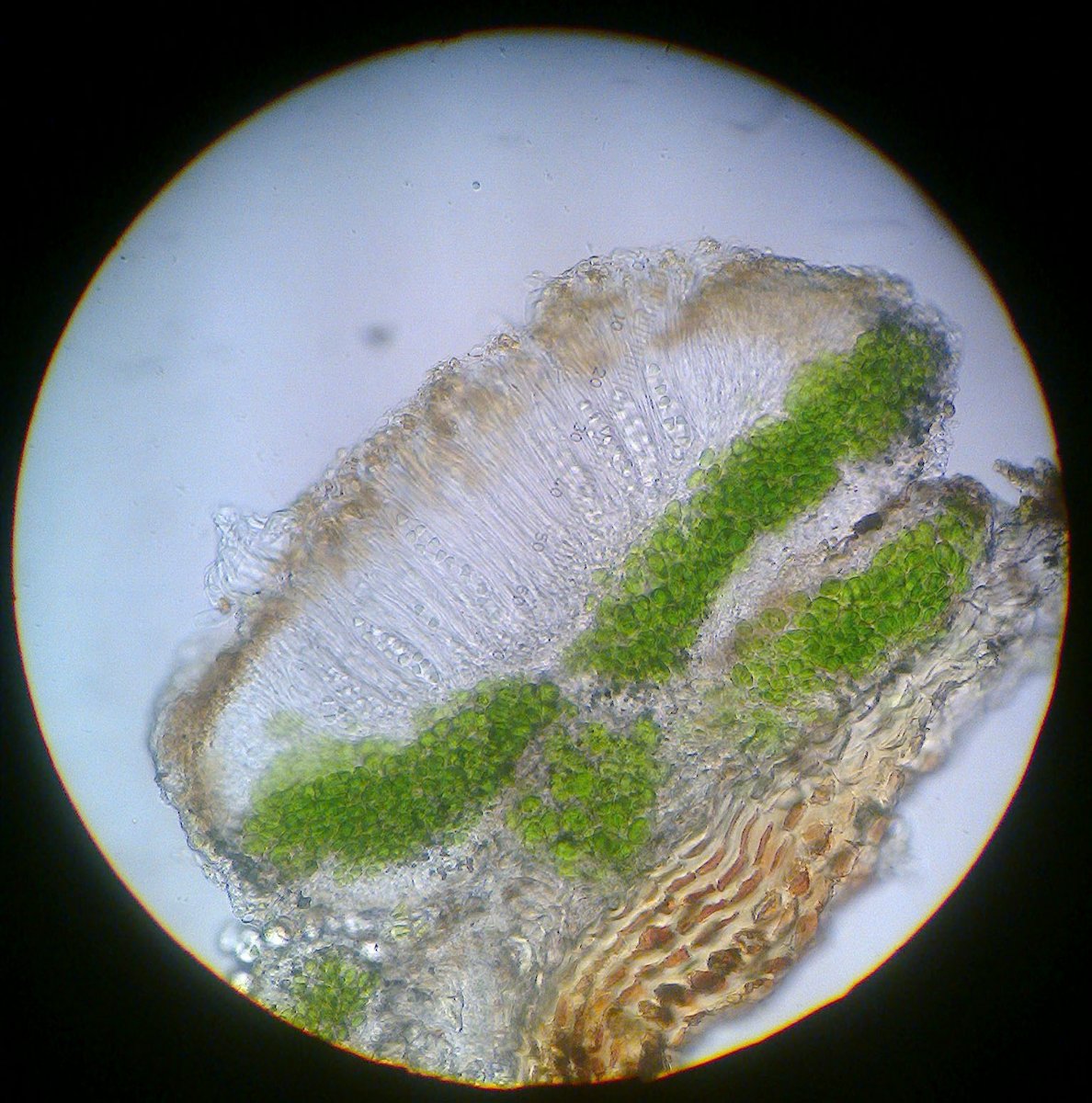
The yellowish apothecia, the 8-spored asci and the thin hypothecium leads me to believe that this could be A. cerinelloides and yet I have a sneaking suspicion that this is just a corticolous and pale A. holocarpa s. str. It was growing on the main trunk of a yet-to-be-identified deciduous tree in a public park. The thallus is about 8mm in diameter.
I am more than happy to follow up with more microscopy, if that should prove necessary. I keyed it using Arup 2009.
First an overview:
[img]https://flic.kr/p/2iCsc3X [/img] and an cross section:
[img]https://flic.kr/p/2iCwhbZ [/img] March 9, 2020 at 3:24 pm #42825The [img]tag doesn’t seem to like flickr urls. Here are the photos: 
[attachment=1]Athallia sp. 1-1bc.jpg[/attachment] 
[attachment=0]Athallia sp. 1-2.jpg[/attachment] [/img]March 12, 2020 at 2:13 pm #42826Hello Jonas, welcome to the forum. I’m no expert in these lichens, but Ulf’s paper says that A. holocarpa is rare on bark (commoner on wood), and when it does it is close to the ground. If that does not match your habitat and the hypothecium measurements are OK, then I guess you have cerinelloides. It’s not easy to judge this last point from your image as it appears that algae are obscuring the hypothecium. Or is there really a continuous layer under the apothecium?
Best wishes
Paul
March 12, 2020 at 7:27 pm #42827Hello Paul, Thank you for your response. You bring up a good point about the hypothecium. I have interpreted it as if the algal layer was mor or less continuous, but checking my photos again I am not 100% sure. I will redo the section and double check – and get some better pictures in the process.
Thanks again,
-Jonas
February 28, 2021 at 8:36 pm #42828It is nearly a year since this query about Athalliawas posted. Forgive me if I revert to ‘ Caloplaca‘ for the purposes of this post. The apothecia are not quite as closely packed and even-sized as I would expect in C. holocarpaor C. cerinelloides. In addition there appears to be a thalline margin which, while becoming rather excluded at a fairly early stage, makes this material very reminiscent of C.pyracea. When the 2009 ‘Flora’ was published, C. pyraceawas considered a rarity, a specialist of Scottish aspen. Since then it has been found widely in England, mainly but not exclusively on aspen. You will see from this tweet that I found it on a London Plane in Exhibition Road, near the Science Museum. https://twitter.com/obfuscans3/status/1002486071379267586 Your photo shows apothecia which are a bit paler than the more typical shades of orange but the morphology is very much like
C. pyraceaand I think you should perhaps consider this possibility. February 28, 2021 at 11:51 pm #42829It has been a while and the material from this observation is now lost, I’m afraid. When I am near the locality again, I will attempt to collect another thallus and retry the ID – you don’t think the apothecia here are too yellow (rather than orange)? March 1, 2021 at 11:38 am #42830Although the younger apothecia in your photo are rather yellowish for pyracea, I am placing more weight on the morphology. The apothecia in various individual Athalliaspecies can be rather variable in colour. In the following close-up from your photo, we can see rather scattered (not closely packed) apothecia with fairly well-developed patches of grey thallus and a grey thalline margin. 
[attachment=0]Screenshot 2021-03-01 at 10.15.05 AM.png[/attachment]
The usually scant thallus ofA. holocarpaconsists of tiny orange blobs and the apothecia have entirely orange margins (including the thalline margin). The thalline margin of A. cerinellais grey but usually hardly apparent and the apothecia normally closely packed. I am rather dubious about my few previous records of A. cerinelloidesand now think that specimens I originally named as such should be considered as corticolous A. holocarpa. I sometimes find A. holocarpaon smooth bark of twigs and small branches of hybrid Black Poplars. Although there is not much in your photo to judge the size of the apothecia by, the little lobes of ciliate
Physciamake me think that they are rather large for A. cerinelloidesor A. holocarpa. We will have to leave this as unresolved but hopefully the discussion has raised your awareness of
pyracea. March 1, 2021 at 11:44 am #42831Indeed it has – thank you for your comments. – Jonas
-
AuthorPosts




- You must be logged in to reply to this topic.