Forums › Forums › Fungi on miscellaneous substrates (not soil or wood) › Typhula erythropus – Redleg Club
- This topic is empty.
-
AuthorPosts
-
December 29, 2015 at 5:51 pm #30047
Hi, Here are some fungi on miscellaneous substrates

If I find any fungus, then I “draw” a 5 m. radius circle around it, and just look very carefully. Firstly, fungi generally have circular growth habits (around trees, as fairy rings, and likely, as mycelial colonies in the ground. Secondly, if you find one fungus you’ll probably find another close by – fungi have “hot spots” and “cold spots”.
Steve
December 30, 2015 at 10:53 am #37758Nice stacked image  January 5, 2016 at 11:11 pm #37759
Hi Steve Yes nice image: The halo effect is common with stacking white objects against a dark background. When I get it, I usually enlarge the image quite a bit and then meticulously and carefully clone the halo away. It only takes about 10 to 15 minuets minuets but improves the end result a lot.
Peter
January 6, 2016 at 11:46 am #37760Ditiola wrote:Hi Steve
Yes nice image: The halo effect is common with stacking white objects against a dark background. When I get it, I usually enlarge the image quite a bit and then meticulously and carefully clone the halo away. It only takes about 10 to 15 minuets minuets but improves the end result a lot.
Peter
Yes I noticed those haloes as well. This is where the retouching available with Zerene Stacker makes things simplehttp://zerenesystems.com/cms/stacker/docs/videotutorials/retouching001/index ” class=”bbcode_url”> http://zerenesystems.com/cms/stacker/docs/videotutorials/retouching001/index 
cheers
Chris
January 16, 2016 at 11:05 am #37761Thanks for the tip! Steve
January 28, 2016 at 10:19 am #37762Chris Yeates wrote:Yes I noticed those haloes as well. This is where the retouching available with Zerene Stacker makes things simple
http://zerenesystems.com/cms/stacker/docs/videotutorials/retouching001/index ” class=”bbcode_url”> http://zerenesystems.com/cms/stacker/docs/videotutorials/retouching001/index cheers
Chris
Hi Chris
I’ve been very happy with the free stacking software but there are times when some artifacts are not easy to remove in Photoshop. My initial experience with Zerene Stacker’s free trial didn’t go as well as I’d hoped but perhaps I’ didn’t give it enough time to explore it thoroughly. In hindsight, downloading it at a quiet time of year would have been more sensible.
Do you stack manually or used some electronic devise such as their recommended
CamRanger camera controllerRegards, Chris
January 28, 2016 at 8:17 pm #37763Chris Johnson wrote:
Hi ChrisI’ve been very happy with the free stacking software but there are times when some artifacts are not easy to remove in Photoshop. My initial experience with Zerene Stacker’s free trial didn’t go as well as I’d hoped but perhaps I’ didn’t give it enough time to explore it thoroughly. In hindsight, downloading it at a quiet time of year would have been more sensible.
Do you stack manually or used some electronic devise such as their recommended
CamRanger camera controllerRegards, Chris
Hi ChrisIt took me a while to get to grips with ZS but I find it indispensible especially with shots of microfeatures where DOF is so minimal. I’d never have got the
Tubulicium vermiferumspores shot sorted otherwise; the spores are sigmoid in three dimensions, standard stacking programs end up with a blurry mess, but: 
[attachment=1]Tubulicium vermiferum 10.jpg[/attachment]
Similarly conidia like the ones figured in this thread on Ingoldian fungi:http://www.ascofrance.com/search_forum/35545http://www.ascofrance.com/search_forum/35545” class=”bbcode_url”> extremelythree-dimensional. With a coverslip on this reduces a bit, and you can wait until the slide starts to dry out and they are forced to shrink a bit (though this often results in them suddenly moving and you have to start again. Zerene with its ability to select from your entire set of original images in real time makes things do-able. I don’t have shares in the company! though the guy behind it is very helpful – I’ve heard he’s even offered assistance to people working with pirated copies – perhaps with a little hint at the end For actually taking micro-images I do it manually with the supplied Tucsen software, then use ZS. For macro-shots I use
https://www.cognisys-inc.com/products/stackshot/stackshot.php ” class=”bbcode_url”> https://www.cognisys-inc.com/products/stackshot/stackshot.php 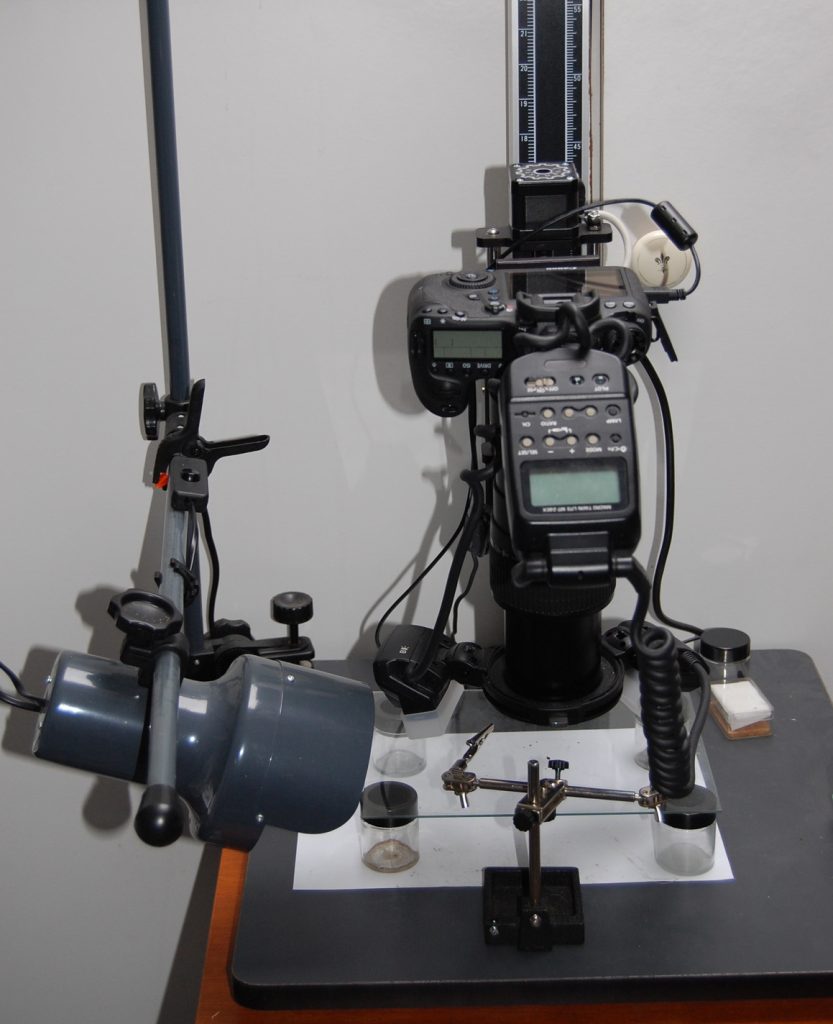
[attachment=0]DSC_6613a.jpg[/attachment]
Not cheap mind. The guys behind this software are pretty amazing; while not related to this topic their Stopshot setup is fantastic – just look at those sample photo’shttps://www.cognisys-inc.com/galleries/stopshot/index.php#33 ” class=”bbcode_url”> https://www.cognisys-inc.com/galleries/stopshot/index.php#33 a particular favourite of mine (though I’m no fan of firearms) is this one of the pellet going into the balloon which doesn’t realise it has been burst yet:
https://www.cognisys-inc.com/galleries/stopshot/index.php#29 ” class=”bbcode_url”> https://www.cognisys-inc.com/galleries/stopshot/index.php#29 Hope Gertrude isn’t too feisty a lady . . . .
cheers
Chris
January 29, 2016 at 9:37 am #37764Hi Chris Stacking micro images has always been difficult and nigh on impossible at times. Small stacks of 2 or 3 can sometime be worthwhile. I think your DIM system has a lot to do with the quality of your micros and ZS does the rest.
I’ve toured the sites you highlight on more than one occasion, they are truly impressive. However, as I use an old photomacroscope with its own integral racking system, it cannot be automated. I manage very well most of the time but with large stacks on maximum magnification, some finer control is desirable.
ZS is still tempting as I’m sure it does everything it purports to, but I don’t believe it’s as easy as the tutorials might suggest. As I’m not the brightest spark when it come to technology, I’ll sit on the fence a bit longer.
Gertrude is demonic – the worst storm this winter. The peak passed through in the early hours with gusts of 85mph, but we have two days of just ‘wild’. The mountainous Atlantic is spectacular.
This thread has drifted well off-topic and Adam might feel inclined to move the relevant parts to a more suitable site.
Regards, Chris
January 29, 2016 at 11:06 am #37765Chris, Have you tried the ‘trial’ version of Helicon Focus and, possibly, Helicon Remote ?? (
http://www.heliconsoft.com/http://www.heliconsoft.com/” class=”bbcode_url”> Steve
January 29, 2016 at 2:08 pm #37766Hi Steve I looked at all available stacking software at the time (about 5 years ago) and tried the free trials. Helicon Focus didn’t seem to be offering anything that Combine ZM wasn’t so I ran with the latter, which was free. I have been very pleased with it (and still am) and any ghosting can be tidied up in Photoshop.
It’s the large stacks on high magnification which produce the problems which are not easily (if at all) dealt with in Photoshop.
Best wishes, Chris
January 29, 2016 at 2:23 pm #37767Chris I was persuaded by Chris to try Zerene and I am sure it would solve most of your problems. Certainly with spores where you have multiple images the detail can often be lost in the “fog” of the many but with Zerene it can be picked back up for the final image.
Mal
January 29, 2016 at 3:23 pm #37768Hi Mal Thanks for that reassurance. I don’t doubt it’s ability but concerned at how user-friendly it is. Did you master it without difficulty or have you been having private tutorials from Chris?

Chris
January 29, 2016 at 10:26 pm #37769Mal and Chris, The same ‘choosing’ of which frames to exclude or include from the final image can be achieved with Helicon Focus too.
See the ‘Retouching’ video over at:
http://www.heliconsoft.com/tutorials/36/http://www.heliconsoft.com/tutorials/36/” class=”bbcode_url”> Hope that helps in your possible choice.
Steve
January 30, 2016 at 11:11 am #37770Hi Steve It’s a long time since I looked at Helicon which must have improved over the intervening years. As Gertrude still has some venom, I’ll look at both over the weekend.
Cheers, Chris
-
AuthorPosts


- You must be logged in to reply to this topic.