
Photographing myxo’s
Forums › Forums › Myxomycetes (slime moulds) › Photographing myxo’s
- This topic is empty.
-
AuthorPosts
-
June 19, 2015 at 12:37 pm #29476
I stumbled accross some nice photos while searching for a species the other day.. https://commons.wikimedia.org/wiki/User:HelenGingerhttps://commons.wikimedia.org/wiki/User:HelenGinger” class=”bbcode_url”> It looks to me like these may have been taken with an SLR/macro lens set-up rather than a stereo. Does anyone have experience of a good macro set-up powerful enough to do this? And/or have one for sale?
Cheers,
John
June 19, 2015 at 2:15 pm #34988Hi, As you will appreciate, there are several methods that could be employed to give the sort of magnification shown in the linked article.
I think that the one common factor will be that anyone photographing small subjects such as these will be focus stacking, to get enough of the subject in focus in the final image.
As for equipment:-
Some people prefer to use such methods as a “Camranger” device, connected to a DSLR and Macro lens via an iPad (or similar).
Some prefer to use DSLR and Macro lens mounted on a focus rail.
Some will use a similar “focus rail” set-up, but using a computer controlled stepper motor to slightly move the camera between shots. (eg. check out the “Stackshot” system).
Personally, I like to keep things simple, and use just a standard (and somewhat ancient) Nikon D80 body, with a Sigma 180mm Macro lens, and a Sigma 1.4x extender, mounted between the camera body and the lens.
Since the D80 has a crop-sensor, and with that lens combination, I can get more than 2x life size straight out of the camera.
I simply put the camera on a rock solid tripod, (Manfrotto 055XB Tripod with 405 Head), and manually “tweak” the focus between each shot.
My focus stacks can vary between three and fifty shots, depending on the subject size, and how much depth of focus I need to give best result.
I never get involved with artificial lighting of any sort, preferring to use ambient daylight.
Often, each individual exposure in the stack can be several seconds duration, but if the tripod is solid enough, and since the subject isn’t moving, long exposures are not a problem.
I use CombineZM focus stacking software, which was downloadable as non time limited full working “freeware” program, from Alan Hadley (Hadleyweb).
That program has since been superceded by CombineZP, but there are many other such software packages that can be purchased. (Helicon Focus, Zerene Stacker, etc. etc.).
I’ve been using CombineZM for five or six years. It does everything I need, very easily, and very well – so I personally have no reason to change to anything else.
Some typical examples using the above method. Click on images to view at full size: –

[attachment=0]Arcyria denudata (1).jpg[/attachment] ImmatureArcyria denudata. 
[attachment=1]Arcyria denudata (2).jpg[/attachment] Almost matureArcyria denudata. 
[attachment=2]Badhamia macrocarpa.jpg[/attachment] Badhamia macrocarpa. 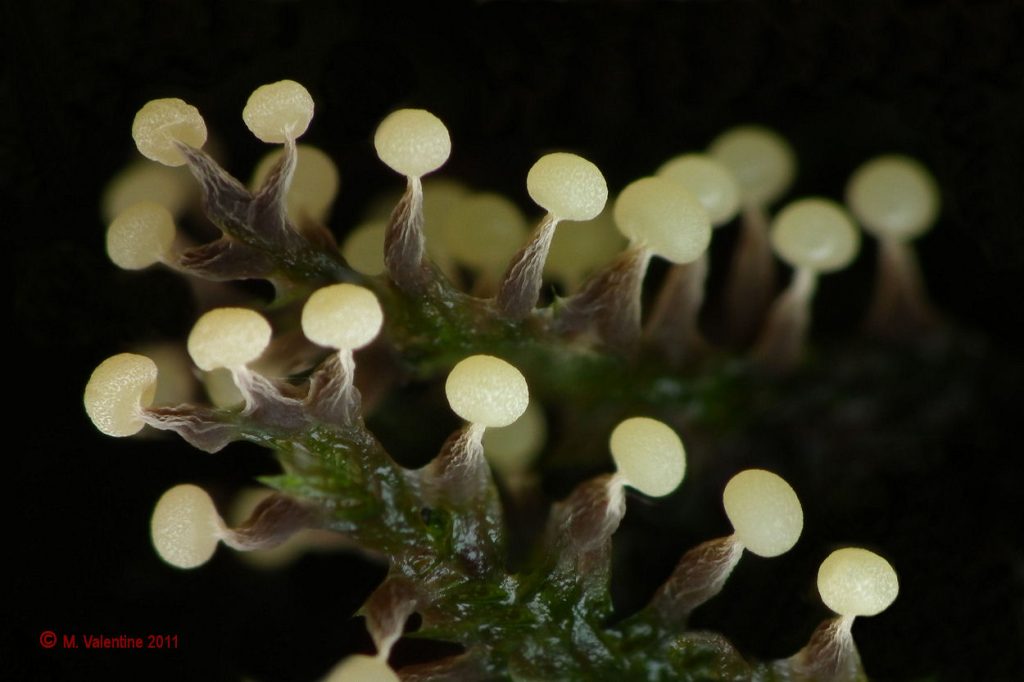
[attachment=3]Physarum album – immature.jpg[/attachment] ImmaturePhysarum album. 
[attachment=4]Physarum album (1).jpg[/attachment] Physarum album. 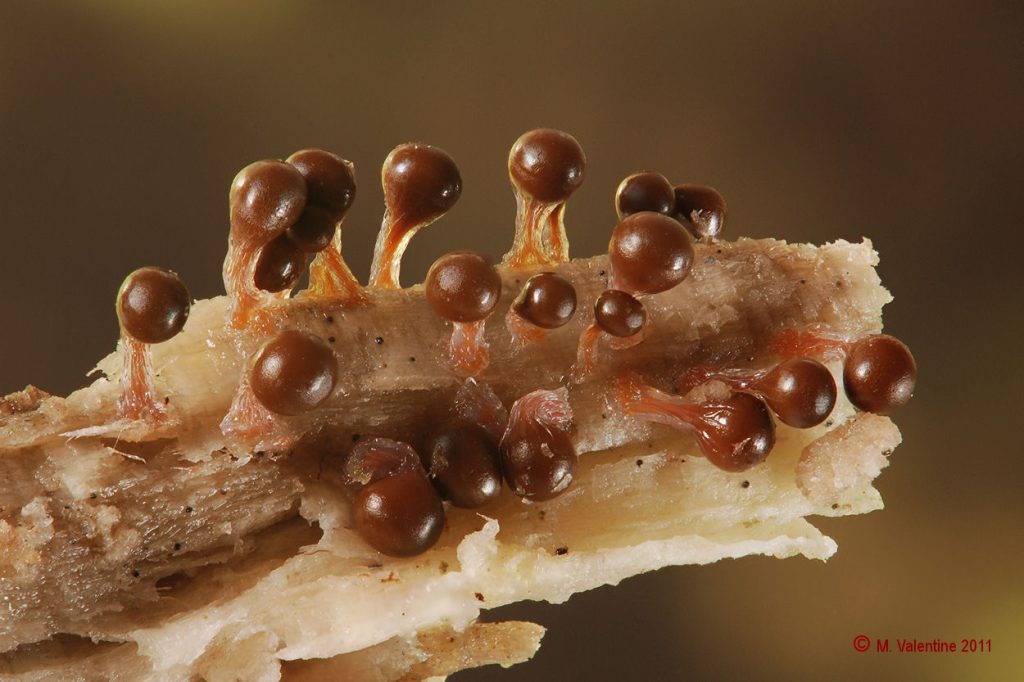
[attachment=5]Trichia decipiens var. olivacea.jpg[/attachment] Trichia decipiensvar. olivacea. 
[attachment=6]Trichia varia.jpg[/attachment] Trichia varia. In actual fact, the image of immature
Physarum albumabove was taken with a Fuji Finepix HS10 bridge camera and Raynox150 supplementary lens. So even what might be considered rudimentary equipment can produce good results with the right subject. 
Obviously, If you need higher magnification, then the above techniques won’t be entirely suitable, as you are entering the realms of the Canon MPE-65 5x macro lens, or would need to be considering employing microscope objectives for the primary lens, or indeed, dedicated ( and very expensive) high magnification macro-rigs such as the “Zeiss Tessovar”, or “InfiniProbe” lens system.
Regards,
Mike.
June 19, 2015 at 3:14 pm #34989Having seen Jens Petersen’s amazing set-up (v. expensive) at the BMS Spring Foray here in Yorkshire in 2011: http://www.mycokey.com/newMycoKeySite/grafic/JensHPetersen2 ” class=”bbcode_url”> http://www.mycokey.com/newMycoKeySite/grafic/JensHPetersen2 Ditiolalooked for a cheaper (though not cheap) alternative – not using photography down a stereo ‘scope. He kindly demonstrated his system to me and I use this variation: http://www.the-digital-picture.com/Reviews/Canon-MP-E-65mm-1-5x-Macro-Lens-Review.aspx ” class=”bbcode_url”> http://www.the-digital-picture.com/Reviews/Canon-MP-E-65mm-1-5x-Macro-Lens-Review.aspx http://www.canon.co.uk/for_home/product_finder/cameras/digital_slr/eos_6d/ ” class=”bbcode_url”> http://www.canon.co.uk/for_home/product_finder/cameras/digital_slr/eos_6d/ http://www.speedgraphic.co.uk/Portals/1/product/images/prd%7BC3648605-A136-4B13-9A3C-44FD9637E24B%7D.jpg ” class=”bbcode_url”> http://www.speedgraphic.co.uk/Portals/1/product/images/prd%7BC3648605-A136-4B13-9A3C-44FD9637E24B%7D.jpg Depth of field at x5 on this lens means you have to take photo’s at 0.2 – 0.25 millimetre intervals so stacking is essential – to make this more straightforward I use:
http://www.cognisys-inc.com/stackshot/stackshot.phphttp://www.cognisys-inc.com/stackshot/stackshot.php” class=”bbcode_url”> 
[attachment=1]DSC_6614.JPG[/attachment] an example of the sort of image produced (not a myxo I’m afraid) is here –
Pirottaea nigrostriata(the largest of the ‘cups’ is around half a millimetre in diameter): 
[attachment=0]Pirnig04a.jpg[/attachment]
Do bear in mind this is a vastly reduced/compressed image (170Kb) of an original circa 100Mb stacked tiff file. So not cheap, but I don’t run a car . . . . and sorry it’s not for saleChris
PS very impressed with
L. Lad‘s images – you couldn’t use my system in the field! I would point out that Combine ZM is fine for that sort of photography, but if you try stacking micro-shots with it the results are a mess – plus you can get unacceptable artefacts – ‘haloes’ – once you start photographing fungi with ‘hairs’; etc. But that’s another story for another day. June 19, 2015 at 3:41 pm #34990Wow.. thanks to you both for the amazing images and comprehensive answers.. A great overview of the options available and different ways of doing things. Plenty of food for thought. It is Father’s day on Sunday..fingers crossed.
June 19, 2015 at 4:16 pm #34991Chris – I have also been trying to stack stereomicro shots without much success. In my current set up with a phototube mounted to the side of a stereo, varying the focus seems to move the images across the cameras field of view from left to right as well as altering the focus. Does anyone know what causes this? I have seen a similar effect before using a compact camera/unilink on an eyepiece.
I thought this was why the images didn’t stack well with the simple cam software I am using. I have used Combine ZP before and I know you can align the images but haven’t tried it yet with current system.
However, I have found stacking works OK for a few frames on a compound microscope. See below – 3 or 4 images stacked.

[attachment=0]Ochroleuca_crop_white800.jpg[/attachment] April 6, 2018 at 4:00 pm #34992I photograph a lot of fungi and slime moulds. The tiny size of many SMs required focus stacking to get pleasing depth of focus but this is impractical in the field (I am usually part of a half-day fungus survey group). Also, the expanded extruded capillitium of SMs blows around in the very slightest of air movement. I use a “100mm” macro lens with a Raynox MSN-202 supplementary lens on the front. That gives me a field of view (on micro4/3) 5mm wide at the closest focus. As my “100mm” is a 50mm plus x2 teleconverter I can remove that for whole colony shots. My macro lens gives 1:2. Other macro lenses may give different minimum fields of view.
At such magnifications, even with a small aperture (f16) set on the lens, the depth of field is less that 1mm!
My macro images (all subjects) can be found here under the name e6filmuser:
April 7, 2018 at 7:27 am #34993Some very impressive images and equipment from two of our leading lights. My field work is rather similar to Mike’s in that I use a heavy tripod and do stacks with natural light. However, I take home really small stuff for studio photography. For this I have an old (1970s) photomicroscope which has a large cast iron base and a 50mm diameter column. Being a microscope, it has the fine focus control which I use manually. It has been converted for digital use. Total weight is over 25kg. For lighting I have a separate fibre optic unit.
October 1, 2019 at 10:55 am #34994MacroMan wrote:
I photograph a lot of fungi and slime moulds. The tiny size of many SMs required focus stacking to get pleasing depth of focus but this is impractical in the field (I am usually part of a half-day fungus survey group). Also, the expanded extruded capillitium of SMs blows around in the very slightest of air movement.I use a “100mm” macro lens with a Raynox MSN-202 supplementary lens on the front. That gives me a field of view (on micro4/3) 5mm wide at the closest focus. As my “100mm” is a 50mm plus x2 teleconverter I can remove that for whole colony shots. My macro lens gives 1:2. Other macro lenses may give different minimum fields of view.
At such magnifications, even with a small aperture (f16) set on the lens, the depth of field is less that 1mm!
My macro images (all subjects) can be found here under the name e6filmuser:
http://www.fredmiranda.com/forum/board/45
I now use a Laowa 25mm x2.5 to x5 ultra macro lens, which gives me a field of view from 7mm down to 3.5mm wide on m4/3:
https://www.fredmiranda.com/forum/topic/1574445/#14689153 Affiliate link:
-
AuthorPosts




- You must be logged in to reply to this topic.