Forums › Forums › Fungi ID requests (post here if you aren’t sure what type of fungus you’ve found) › Periconia species
- This topic is empty.
-
AuthorPosts
-
April 15, 2020 at 9:23 am #31643
Hi everyone, I’m hoping the forum community will be able to help me. I’m shielding family members in mid-Wales and have my microscopes with me but no means of measuring spores and few books. These are all in Surrey!
I’ve found what I believe to be a Periconia species on dead nettle stems. If I remember rightly there are two possibilities: P byssoides and P minutissima. I’d usually reach for Ellis & Ellis but my arm isn’t long enough!
I think some of the important characters are branching within the head of the conidiophore and the presence/absence of septa just below the head – but I could be wrong.
Can anyone ID from the following photos, please?
April 15, 2020 at 12:40 pm #42929Hi Fay Had you had Ellis & Ellis to hand I’m sure you would have sorted this one out. The two usual
Periconiasuspects on dead nettle stems are P. byssoidesand P. cookei(the former much the more common in my experience). Both have unbranched heads, and yes, the presence of a transverse septum in the conidiophore head is the key identification feature; this is not always easy to see, or indeed show in a photograph. In this plate the two lower left images are of the same “head” at different focusses; with the right hand one I then brightened the dark level up to show the septum (arrowed). I suspect that some records of P. cookeimay be down to people simply not being able to make out that septum (I certainly made the odd slip when I was starting out looking at these fungi). 
[attachment=0]Periconia byssoides0a.jpg[/attachment]
However, you don’t have aPericoniathere. That genus has one-celled globose conidia. Your fungus clearly has septate conidia, somewhat constricted at the septa; and branched apices. Your fungus is Dendryphion comosum, also very common on dead Urticastems; it is well dealt with here on Paul Cannon’s excellent website: http://fungi.myspecies.info/all-fungi/dendryphion-comosum ” class=”bbcode_url”> http://fungi.myspecies.info/all-fungi/dendryphion-comosum Mediafor more pictures. Hope that helps
Best wishes
Chris
April 15, 2020 at 1:35 pm #42930Thanks, Chris. I’d forgotten that Periconia species have globose, single-celled spores. Thanks for the ID and the link to the FGBI website. I agree this fits perfectly. The sizes are in the right area as well. Although I can’t measure at the moment, I’ve got a sense of size based on seeing things I know.
I’ll record this one now. Don’t think I’ve ever seen it before.
April 17, 2020 at 10:39 am #42931I think I’ve just found Dendryphion comosumagain but on a dead fennel stem this time. According to the FBGI website entry, the fungus appears to occur on a wide range of herbaceous stems so this is probably right. Few spores present this time and all 3-septate. April 17, 2020 at 7:15 pm #42932Fay Newbery wrote:
I think I’ve just foundDendryphion comosumagain but on a dead fennel stem this time. According to the FBGI website entry, the fungus appears to occur on a wide range of herbaceous stems so this is probably right. Few spores present this time and all 3-septate.
I’ve just checked and I have recorded this on 15 different species in Yorkshire. It is most common (or commonly reported) onUrtica dioicaand on a range of umbellifers – especially Heracleum sphondylium. April 17, 2020 at 8:05 pm #42933Chris Yeates wrote:
I’ve just checked and I have recorded this on 15 different species in Yorkshire. It is most common (or commonly reported) onUrtica dioicaand on a range of umbellifers – especially Heracleum sphondylium.
Thanks for that reassurance, Chris. Fennel sounds like a likely substrate and the microscopy showed no difference apart from mean number of septa.I’ve now got three discomycetes to look at on the fennel. They’ll challenge me even more.
Which discomycetes have you recorded most commonly on Apiaceae? It might speed things up if I checked against your list first. Maybe a new thread on Discomycetes on fennel?
April 21, 2020 at 7:46 pm #42934Have now found one of the Periconia species on nettle. 
[attachment=2]Periconia sp 20-101 b – jpeg.jpg[/attachment]
There is definitely a septum at the base of the ‘head’ and possible signs of branching or spore chains at that point.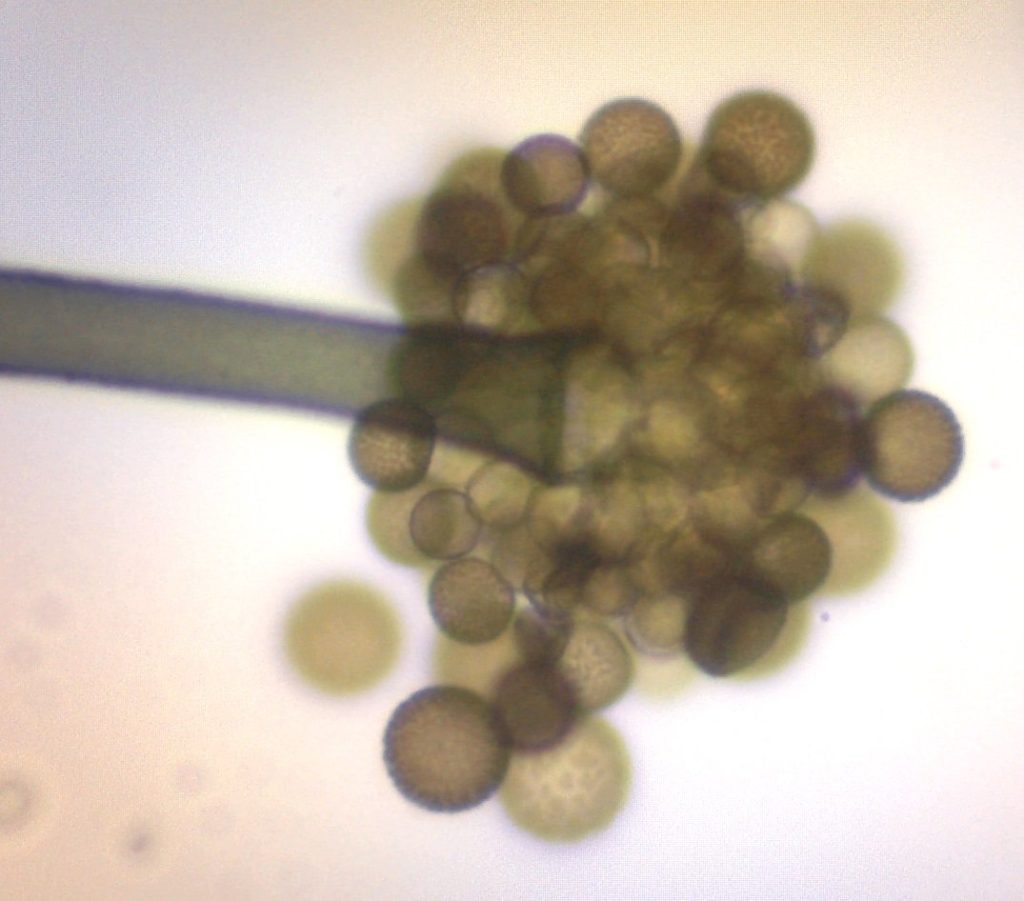
[attachment=1]Periconia sp 20-101 c – jpeg.jpg[/attachment] 
[attachment=0]Periconia sp 20-101 d – jpeg.jpg[/attachment]
Not sure whether this is P. byssoides or P. cookeri. Can anyone help, please?May 2, 2020 at 8:38 am #42935Loving this post nice1 👌 -
AuthorPosts


- You must be logged in to reply to this topic.