
One to look out for
Forums › Forums › Fungi on miscellaneous substrates (not soil or wood) › One to look out for
- This topic is empty.
-
AuthorPosts
-
February 16, 2019 at 8:28 am #41367
Interesting reading: sequencing has produced some unlikely associations. Makes life challenging for the amateur. Regards, Chris
February 16, 2019 at 11:32 am #41368Chris Johnson wrote:
Now much farther north … on the first leaf I picked up😯 Thanks for bringing this to our attention.
Chris
It took me over 30 leaves!! Your leaf looks brown. Was it still slightly leathery as if it hadn’t been fallen for very long?
Fay
February 16, 2019 at 12:26 pm #41369Fay Newbery wrote:
Chris Johnson wrote:
Now much farther north … on the first leaf I picked up😯 Thanks for bringing this to our attention.
Chris
It took me over 30 leaves!! Your leaf looks brown. Was it still slightly leathery as if it hadn’t been fallen for very long?
Fay
Yes, just as you describe. I looked at about 40 ‘promising’ (right age) leaves and found four with the fungus.
Chris
February 16, 2019 at 5:05 pm #41370In New Zealand, JAC informs me Griseliniais not particularly coastal, it is also the less common genus for the Physalacria. https://avh.ala.org.au/occurrences/search?taxa=griselinia+littoralis#tab_mapView ” class=”bbcode_url”> https://avh.ala.org.au/occurrences/search?taxa=griselinia+littoralis#tab_mapView The commoner hosts are
Pseudopanax crassifolius& Ps. arboreus: https://avh.ala.org.au/occurrences/search?taxa=Pseudopanax+crassifolius#tab_mapView ” class=”bbcode_url”> https://avh.ala.org.au/occurrences/search?taxa=Pseudopanax+crassifolius#tab_mapView https://avh.ala.org.au/occurrences/search?taxa=Pseudopanax+arboreus#tab_mapView ” class=”bbcode_url”> https://avh.ala.org.au/occurrences/search?taxa=Pseudopanax+arboreus#tab_mapView Pseudopanaxis a member of the ivy family, Araliaceae. It has an interesting growth form, starting with the lower leaves being strap-like and armed with vicious teeth. http://www.terrain.net.nz/friends-of-te-henui-group/trees-native-botanical-names-m-to-q/lancewood.html ” class=”bbcode_url”> http://www.terrain.net.nz/friends-of-te-henui-group/trees-native-botanical-names-m-to-q/lancewood.html When the tree gets to a certain height the leaf form changes; the reason for this was an adaptation to discourage browsing by Moas
https://en.wikipedia.org/wiki/Moahttps://en.wikipedia.org/wiki/Moa” class=”bbcode_url”> Pseudopanax crassifolius
isgrown in this country: https://www.burncoose.co.uk/site/plants.cfm?pl_id=3487https://www.burncoose.co.uk/site/plants.cfm?pl_id=3487” class=”bbcode_url”> Griselinia. If the fungus only occurs on the older, broader leaves, then the plant would have to be fairly old and have survived quite a number of winters – so a bit of a challenge to find the fungus on that. I would suspect that keeping ones eyes open in Southern botanical gardens and arboreta is the best bet – especially some of those splendid ones in Cornwall. I used to work in museums so am hard-wired to love how these stories can spiral out and inter-connect. Interesting winter study – plus the bonus of a fungus which can be found at this time of year. (Come on Mike! this must be around in coastal Lancashire . . . .)
Chris
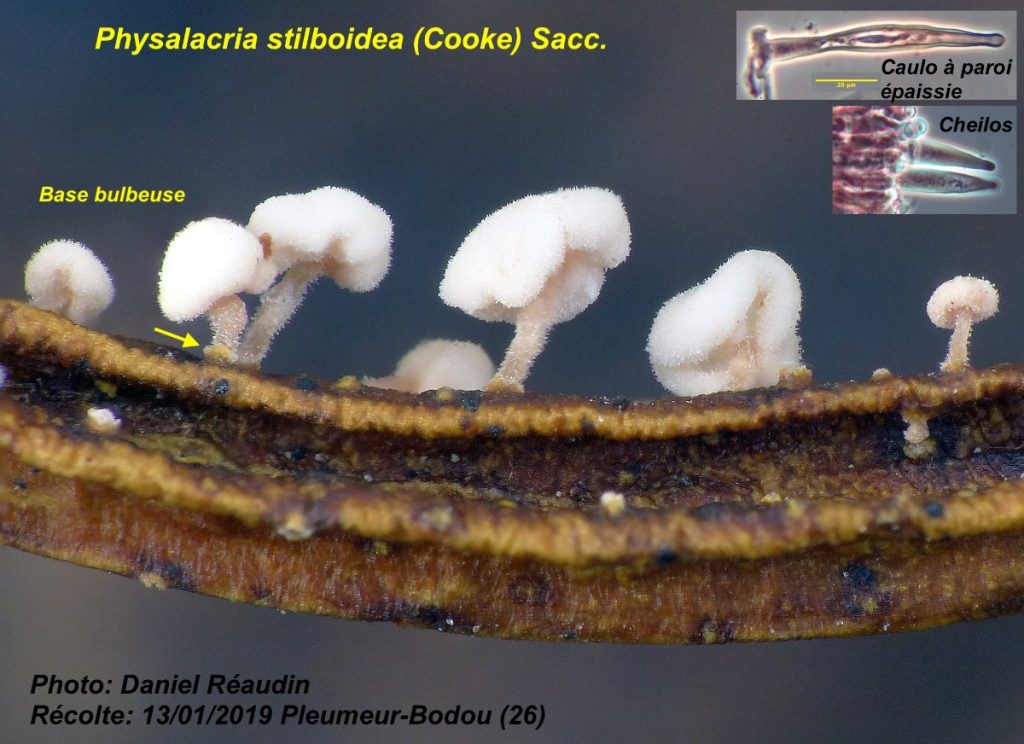
March 3, 2019 at 7:44 pm #41371Hi there, just to let you guys know that we have recently identified this species in France. Found in January 2019, in Bretagne, growing on Griselinia leaves. We think it is the first french record of this species.
The specimens are being sequenced. I’ve asked just Jerry Cooper to share his sequences with we to see if they match well.
Here is a picture of our collection.
All the best,
Hervé
[attachment=0]Physalacria stilboidea 1.jpg[/attachment] March 4, 2019 at 1:21 am #41372Bonsoir Hervé Magnifique! Je pense qu’il ne fait aucun doute que vous avez trouvé cette espèce.
Amitiés
Chris
March 4, 2019 at 8:42 am #41373Is it everywhere where there is Griselinia? but no-one has looked for it before. The lesson to be learned is that when you import exotic plants into the UK then you don’t really know what else comes in with them and what effects they might have everything else.
Having said that I think this fungus is specific to these plants with leaves that are like leather and presumably difficult to decompose.
Brilliant picture
Gary
March 4, 2019 at 10:09 pm #41374gary wrote:
Is it everywhere where there is Griselinia? but no-one has looked for it before.
As I said in a previous post:It would be interesting to know how the fungus spreads,
I would suspect that it survives as an endophyte. From the RHS website it would appear that Griselinia littoralisis propagated by semi-hardwood cuttings, so the fungus could well be moving around with the plantsand we are dealing with a series of cloned populations.” gary wrote:The lesson to be learned is that when you import exotic plants into the UK then you don’t really know what else comes in with them and what effects they might have everything else. . . .
Of course New Zealand, the natural home ofGriselinia, is extremely hot on biosecurity. It’s very tempting to wonder (at the danger of getting a wee bit political) what the effect of Brexit and an increasing desperation to do deals with all and sundry across the globe – at whatever cost – may have. Chris
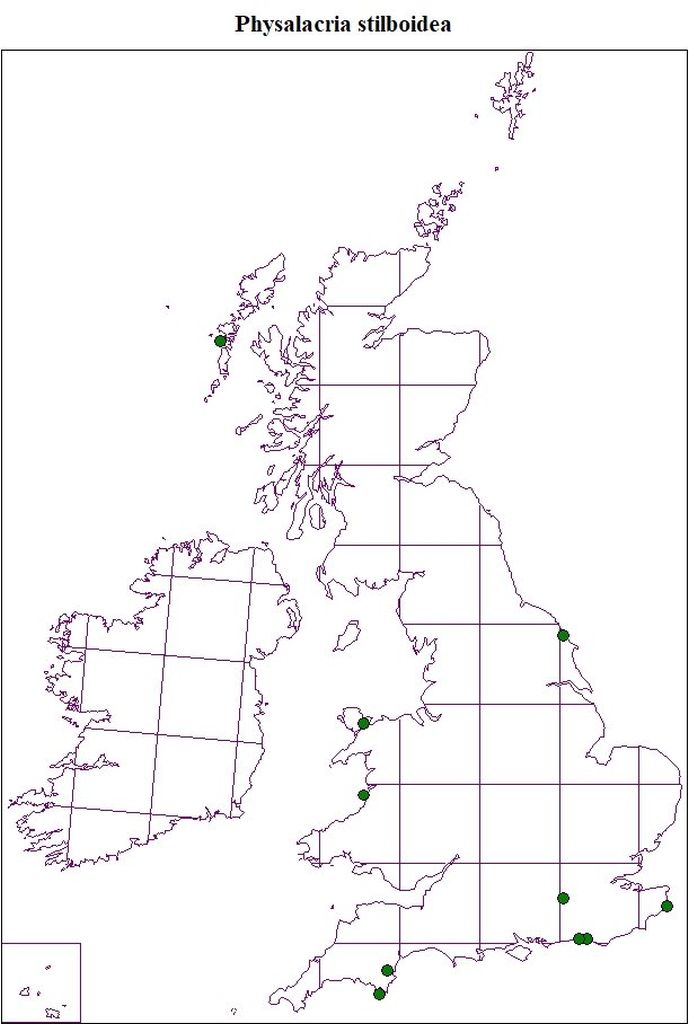
May 1, 2019 at 4:38 pm #41375I have been in touch again with Martyn Ainsworth at Kew. He has kindly given me the accurate grid reference for the Anglesey record, plus a couple of new records of his. He agrees that the fungus is probably an endophyte. Here is the amended map – I’ve made the dots a bit bigger for ease of use.
Chris
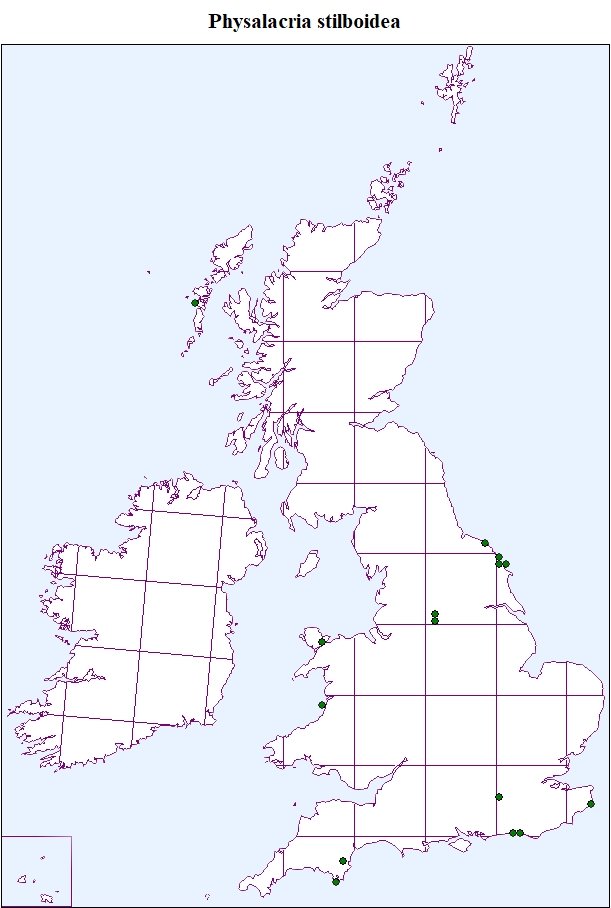
[attachment=0]Physalacria stilboidea.jpg[/attachment] December 10, 2019 at 1:33 am #41376Since the last update I’ve found it in a couple of other 10km squares in the Scarborough/Filey area, and it’s also been found in Whitby, further up the Yorkshire coast. Today I found it in Shepley, near Huddersfield, so the distance from the sea has been increased to around 52 miles, and this find was at 188 metres above sea level.
So here is the current distribution map, based on the data I currently have. (Actually now – updated – in the following post).
December 11, 2019 at 9:06 pm #41377Amazed how quiet this site is – there’s still a lot to see out there. I spotted what I thought was a Griseliniabush from the bus a couple of days ago. Had a chance to check today – and there was the fungus – so another dot . . .
[attachment=0]Physalacria stilboidea.jpg[/attachment] December 14, 2019 at 5:57 pm #41378Hi, just to let you know that our publication is now out (in french, sorry).
Cochard H, Réaudin D. 2019. Physalacria stilboidea (Cooke) Sacc., espèce exotique nouvelle pour la France. BFMDS 253, 11-16.
http://herve.cochard.free.fr/pdf/Cochard-Reaudin-2019.pdf Thanks for the discussion.
Hervé
December 16, 2019 at 8:08 pm #41379Bonsoir Hervé Pas besoin de s’excuser, le français est une belle langue
❗ I subscribe to BFMDS as well – as part of my membership of Ascomycete.org – I use it as a way to keep my schoolboy French alive.
Excellent paper and it is good that
UK Fungihad a part to play. Joyeux Noel
Chris
December 19, 2019 at 10:28 pm #41380Mon Dieu Les Francais est arrive? Courage mes braves.
A
February 13, 2020 at 10:34 pm #41381Physalacria stilboideaseen today in Shepley, S of Huddersfield, highest site yet I think, at 234 metres. Also interesting is that it was on a Griseliniavariety with variegated leaves. I have found two
Griseliniashrubs by the baptist chapel at Scapegoat Hill – pictured here: https://en.wikipedia.org/wiki/Scapegoat_Hillhttps://en.wikipedia.org/wiki/Scapegoat_Hill” class=”bbcode_url”> -
AuthorPosts




- You must be logged in to reply to this topic.