
Literature and resources for general fungi
Forums › Forums › General fungi discussion › Literature and resources for general fungi
- This topic is empty.
-
AuthorPosts
-
January 23, 2018 at 11:48 am #34921
Fungi Nordica – possible future reprint? see: https://www.facebook.com/groups/18843741618/?multi_permalinks=10154932074871619¬if_id=1516705299000114¬if_t=group_highlights&ref=notif October 16, 2018 at 10:50 pm #34922I see the Norweigian Mycena site has been taken down. Will remove it from the index. October 17, 2018 at 6:50 am #34923Adam, Are you aware of any reason? Norwegian Mycena has been a fantastic site! Mark October 17, 2018 at 8:11 am #34924marksteer wrote:
Adam, Are you aware of any reason? Norwegian Mycena has been a fantastic site! Mark
No idea, sorry. One for Andreas I would think.
October 17, 2018 at 3:17 pm #34925Its probably because it is now in book form so they want people to buy it  October 17, 2018 at 3:52 pm #34926
Maybe some current problem with the website? I can access the main site : –
https://mycena.no/ as per norm.Most of the individual species pages are also available from the index list
Just some of those pages are giving the “page cannot be reached” error message.
Regards,
Mike
November 21, 2018 at 6:55 am #34927Dear all, the Cortinarius Fotoflora Project Team has been reduced for another important person by the death of Hakan Lindstroem earlier this year. The remaining team people thought since longer time about not continuing this series any more and furthermore now decided that they do not want to sell the books anymore and searched for someone (or several) to take the stock of their remaining issues.
So we (= myko-shop) have bought the remaining issues of the english version, which is nearly sold out – at least the complete series vol. 1-5 (< 10 left, only the latest vol. 5 is still available in quantities). So we at myko-shop can at the moment offer all issues of the english version to reduced prices, means that the whole series of vol. 1-5 is only 250 Euro, including 3 ring binders (originally that were four) and without the separating sheets with imprinted section names (which are +/- obsolete anyway in many groups due to molecular inverstigations …) best wishes, Andreas
November 21, 2018 at 8:18 am #34928adampembs wrote:
I see the “The Genus tricholoma in Britain” by Geoffrey Kibby has been re-listed as a 2nd edition (2017) with the original being published in 2012.
Hi Adam
Did you ever get an answer to this? I would be interested to know too.
Cheers, Chris
November 21, 2018 at 3:01 pm #34929Yes, its a revision that’s all. A couple of species name changes. November 21, 2018 at 5:29 pm #34930Thanks Adam. Regards, Chris
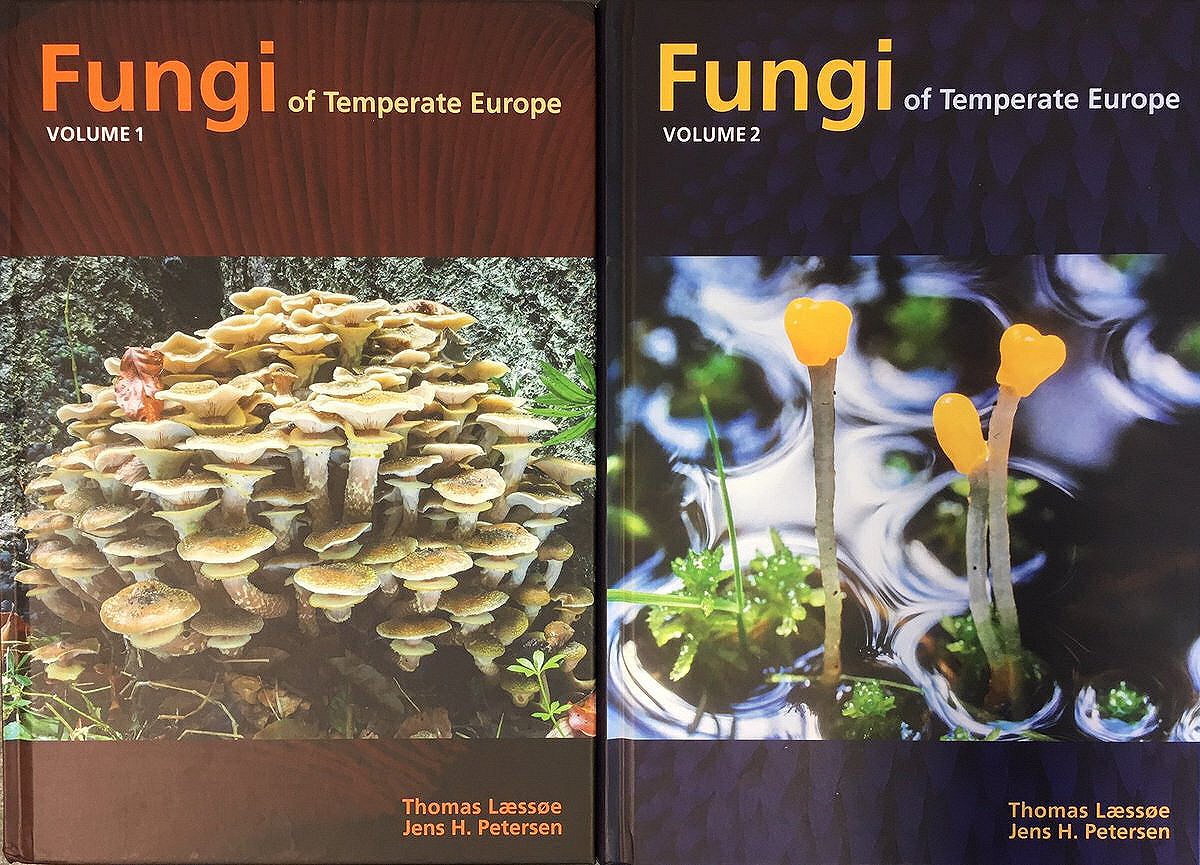
August 28, 2019 at 2:02 pm #34931Just a quick heads up for those who may not yet be aware: – Fungi of Temperate Europe. 2 volumes. – Thomas Læssøe. and Jens H.Petersen. – Princeton University Press, 2019. 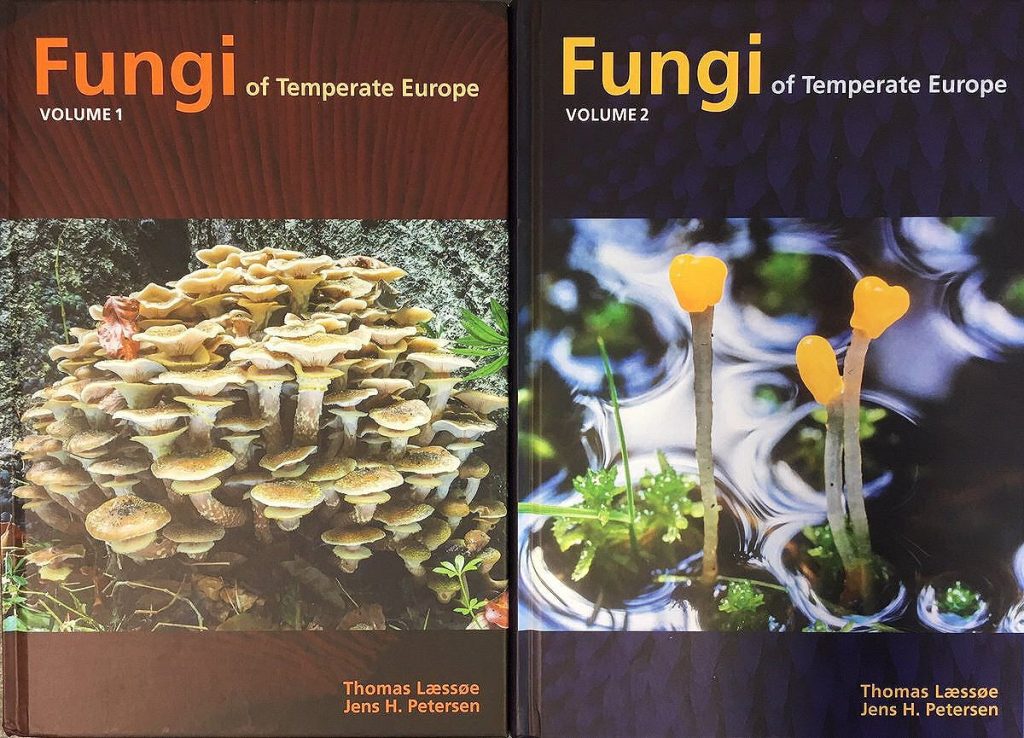
[attachment=2]FOTE1.jpg[/attachment]
Publisher’s Description: –” Fungi of Temperate Europe is one of the most comprehensive mycological guides ever published. Featuring more than 7,000 photographs, this lavish two-volume set treats more than 2,800 species of fungi across the region.
Including agarics, boletes, chanterelles and morels but also more obscure groups such as cyphelloids, cup fungi, pyrenomycetous fungi and hysterioids, this guide takes an unprecedentedly broad approach to communicating fungal diversity. All species are illustrated with one or more photographs and information is given on morphology, ecology and distribution within temperate Europe. Furthermore, 1,500+ species are discussed as potential look-alikes. The books are divided into eighty “form groups,” each starting with an innovative comparison wheel with guiding photos, distinguishing characteristics and drawings of essential microscopic features. Poisonous and edible species are colour coded within the text”.
Having just bought a copy, I can say that this is something of a masterpiece!
The book has an “official” price tag of £95.00, but currently, is readily available at just over £60.00 from a number of sellers.
Obviously, the book includes many species that aren’t (yet?) found in Britain, but a great many are, and from my initial browsing, I already think it was worth every penny!
The two volumes contain over 1700 pages between them, and as might be expected, the content is very extensive. Superb photographs throughout, and with what I would say is informative but not overly technical description for each included species.
Size-wise, the books are approximately 28.5cm tall and 20cm wide. (Very similar in page size to Fungi of Switzerland).
The two volumes together measure about 9cm across the spines, and the set weighs in at above 5Kg.
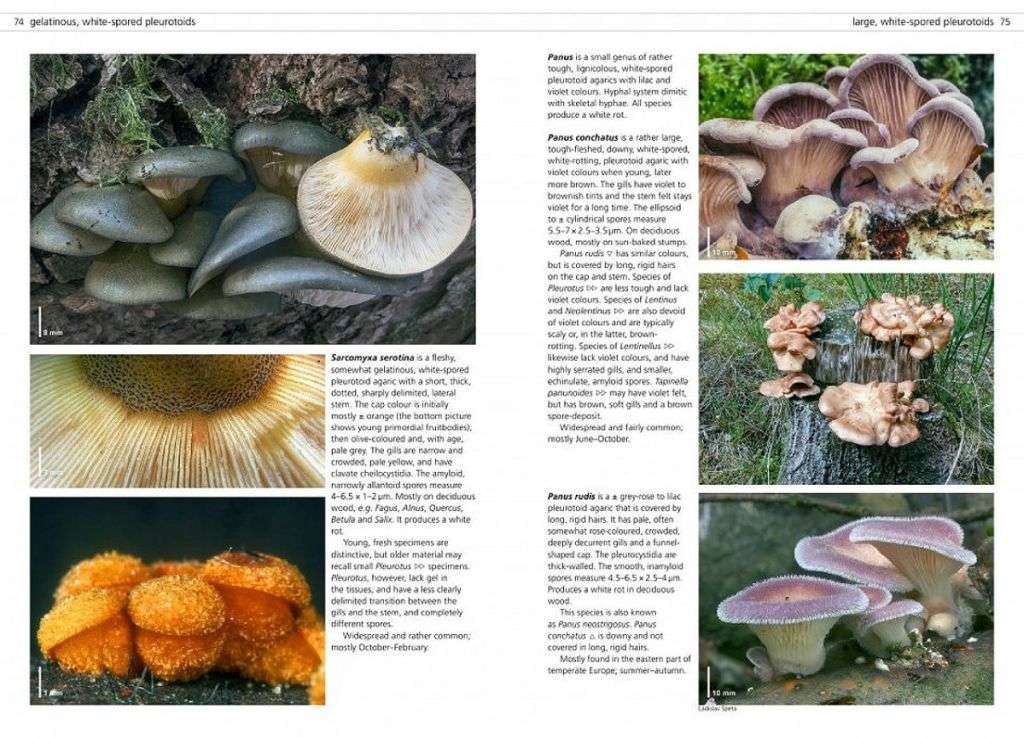
[attachment=0]FOTE3.jpg[/attachment] 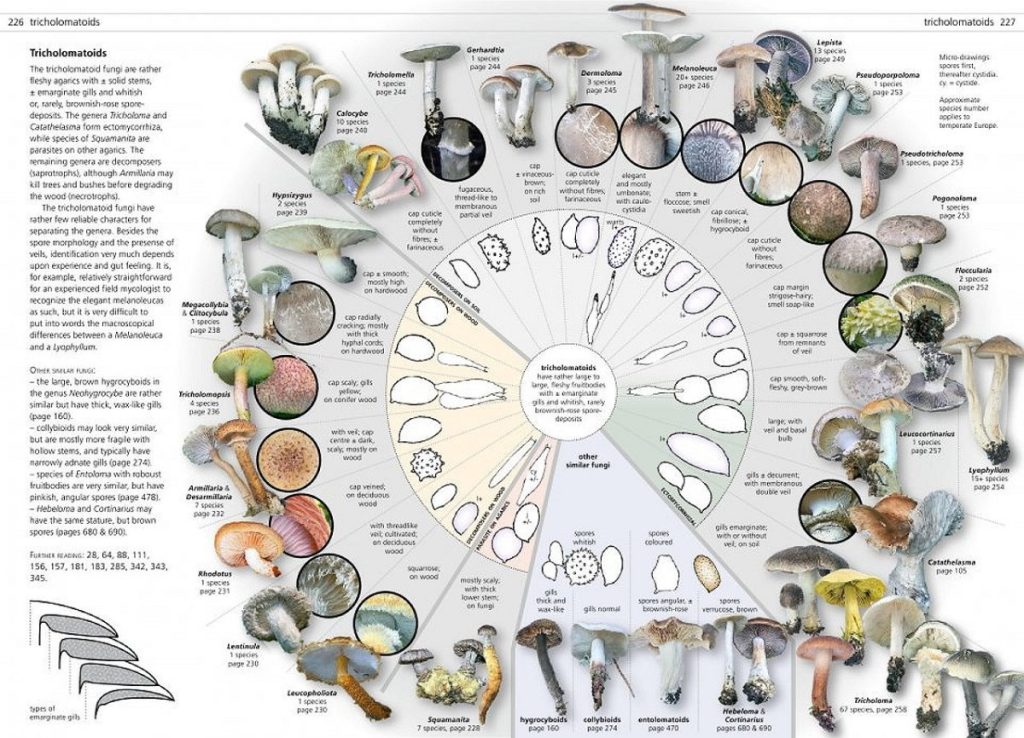
[attachment=1]FOTE2.jpg[/attachment]
The numerous “identification Wheels” offer a novel and useful approach to rapid identification of genera, and it is worth noting that they are all available as a free PDF Download from the MycoKey website (download link below).http://www.mycokey.com/Downloads/FungiOfTemperateEurope_Wheels.pdf NB: at over 180 megabytes, it is a very large download – so be prepared!
Note also that there appears to be an error in the PDF, in that the Boletes section is missing – but it is complete in all other respects.
(I have emailed Jens Peterson in case he was not aware of the problem, asking if the PDF might be revised to include the missing content).
Regards,
Mike.
August 28, 2019 at 5:18 pm #34932Looks good. What geographical area does it cover? With global warming and being on the south west coast, in Pembrokeshire, we’ve come across a couple of species from Iberia and we are at the southern end of the Funga Nordica range. I’ve often wished for a Funga Southica.
:geek: August 29, 2019 at 12:09 am #34933adampembs wrote:. . . What geographical area does it cover? . .
Hi Adam,It says in the preface that they have defined “temperate Europe” as: – from Northern Norway down to the Alps, Northern France-Northern Spain, the Baltic States, Poland, and parts of the Steppe region, Hungary & Ukraine.
Regards,
Mike.
October 31, 2019 at 3:38 pm #34934Lancashire Lad wrote:
Fungi of Temperate Europe. 2 volumes. – Thomas Læssøe. and Jens H.Petersen. – Princeton University Press, 2019. . . . . The numerous “identification Wheels” offer a novel and useful approach . . . .
Note also that there appears to be an error in the PDF, in that the Boletes section is missing . . . . .
The online “Wheels” PDF has been revised. – I Just downloaded it again, and the Boletes “wheel” is now included.
I’ve only just noticed that the printed book includes one of my Photos –
Pleurotus cornucopiaeon page 86. – Fame at last. 😆 😳 (I had completely forgotten that Jens Petersen contacted me a couple of years ago to ask for my permission to use it).
Regards,
Mike.
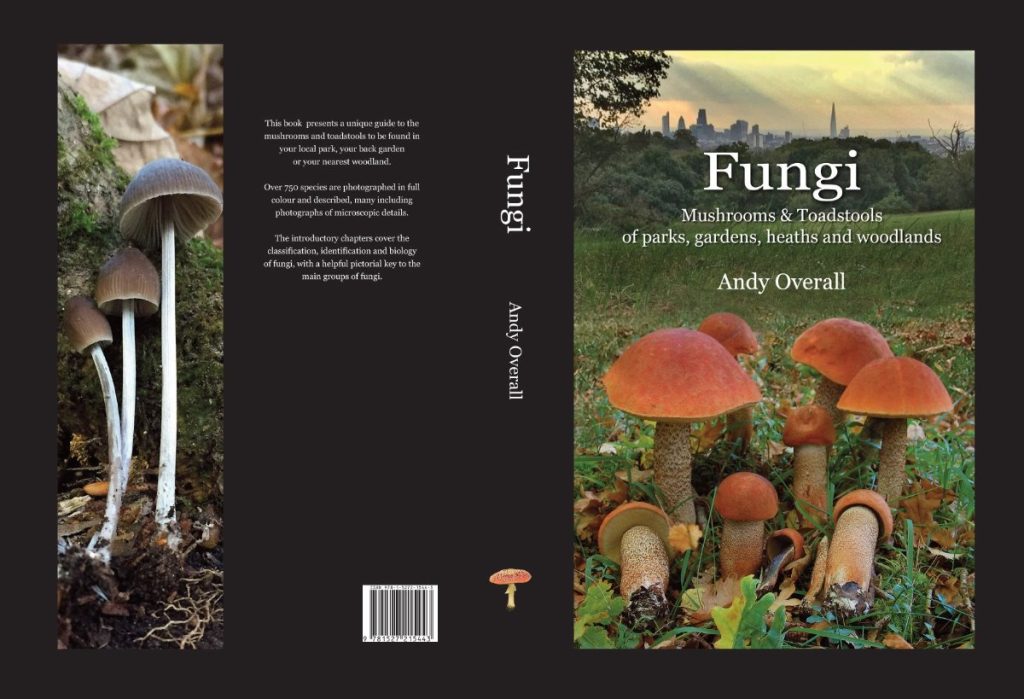
October 31, 2019 at 4:18 pm #34935Another heads up. – For another mighty tome! “Fungi – by Andy Overall” (Assisted by Geoffrey Kibby).
[attachment=1]Fungi – Andy Overall.jpg[/attachment] [attachment=0]Fungi – Andy Overall.jpg[/attachment]
Self-published, but available from various sellers from about £53.00567 pages. – Approximately 30 x 21 x 4cm. – And weighing in at about 2.4kg.
For the most part in a similar layout style to Fungi of Switzerland, but with a broad spectrum across the many included genera, all in the one volume. – Three species described on left hand page, with three species photographs on right hand page.
Like most single volume books, it can only show a small percentage of what is out there, but what is included is informative and well thought out.
My copy came with a stuck in errata sheet containing corrections for 13 errors, but once noted and identified on their respective pages, these don’t detract from the books usefulness.
Author’s product description: –
“This book is a large (A4-size) photographic reference guide to the mushrooms and toadstools of parks, gardens, heaths and woodlands of Great Britain and Europe. Though the vast majority of fungi illustrated in this book have been recorded from, and can be encountered in the Greater London Area, many species appear in urban areas across Britian. Over 750 species are described and photographed in full colour, many including photographs of microscopic details. The description with each entry gives scientific nomenclature, including synonyms where applicable, and the vernacular name; a short description of the typical habitat; a description of the macroscopic features, such as the cap, gills, stem, ring, flesh, and the mushroom’s smell and taste; a description of microscopic features, such as spores, spore print, basidia and cystidia; and a section with notes on confusion species or unique features. Several families feature a full-page general introduction. The introductory chapters cover the classification, identification and biology of fungi, with a helpful pictorial key to the main groups of fungi. This book is an essential tool for those working within conservation and ecology of urban environments, and for both beginners and seasoned field mycologists”.Overall, (no pun intended!), I’d say that it would be a worthwhile book to have in anyone’s mycological library.
Regards,
Mike.
-
AuthorPosts




- You must be logged in to reply to this topic.