- This topic is empty.
-
AuthorPosts
-
January 1, 2024 at 10:59 am #32747
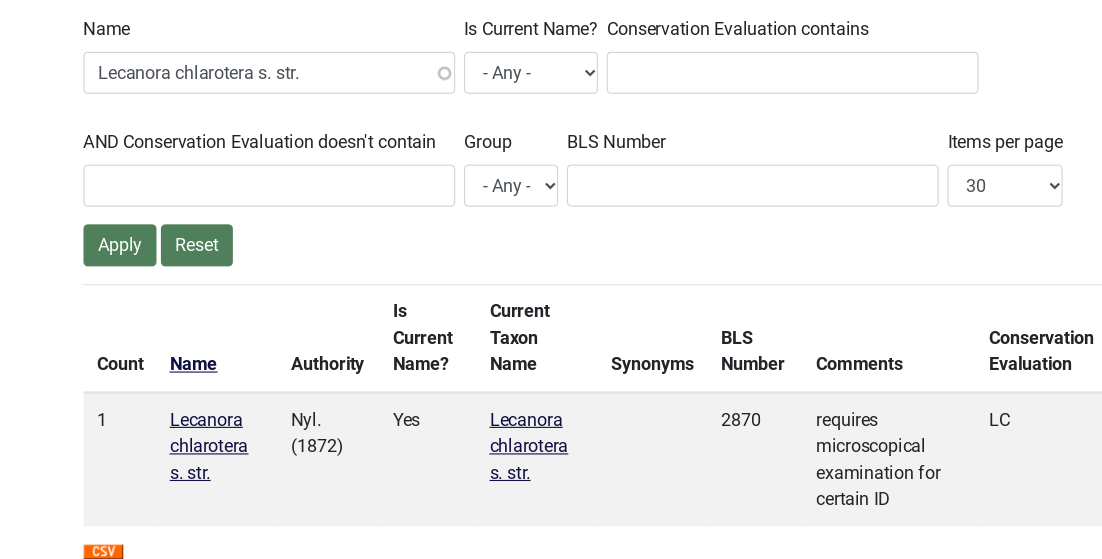
I am pleased to report that we now have a new BLS number (2870), reserved for critically identified specimens of Lecanorachlaroteras. str. Many thanks to those who were involved in prompting and implementing this addition. 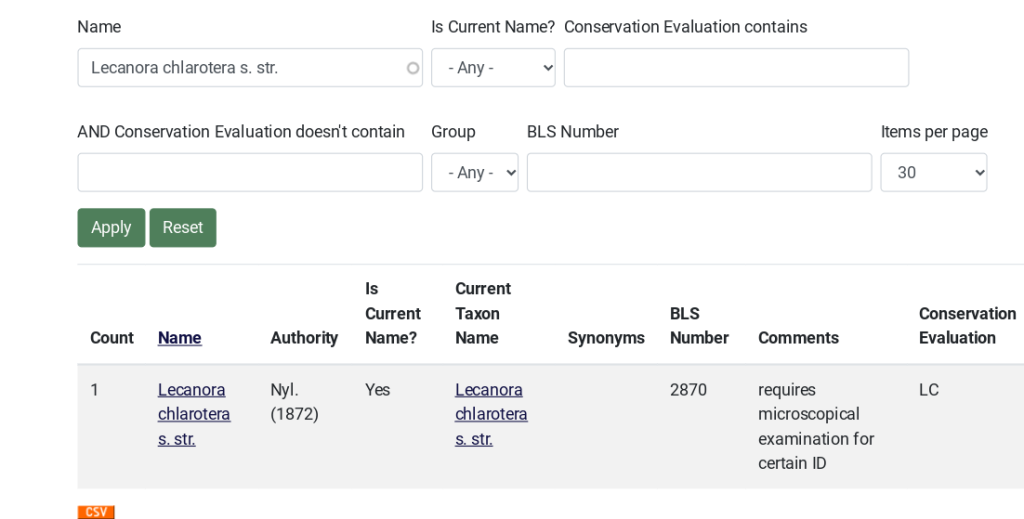
[attachment=0]Screenshot 2024-01-01 10.05.18 AM.png[/attachment] All previous records of ‘
Lecanora chlarotera‘ will retain the number 0639 (unless they have been critically determined using microscopy). Most of these records will be field records, or will have been otherwise determined before we were aware of the widespread occurrence of the taxon which we are currently recording as Lecanora hybocarpa. These previous records of Lecanora chlaroteras. lat. (0639) will include many records of L. hybocarpa, and also misidentified records of L. argentata, L. horiza, L. pulicarisand corticolous L. campestris. I would suggest that 0639 is still the number to use in cases of doubt, for field records when working in an unfamiliar region and for those inexperienced in distinguishing members of the L. subfuscagroup. It will be very interesting to map the different geographical ranges of L. chlaroteras. str. and L. hybocarpaand it would be unfortunate if the database was contaminated with casually and potentially incorrectly identified specimens. I have now had the opportunity to examine what I consider the real
L. chlaroteras. str. thanks to the generous loan of a specimen collected in Ireland. This makes me even more certain that this species appears to be absent from my region (by which I mean Bedfordshire and neighbouring counties); I have not encountered a single specimen of it here. L. hybocarpais by far the most common corticolous member of the subfuscagroup in my region; it is the one that is ubiquitous on bark of all sorts. L. argentataturns up as an occasional thallus within mosaics of L. hybocarpaand Lecidella elaeochroma, but it is outnumbered by L. hybocarpaby many hundreds to one. L. argentataalso occurs rarely near the bases of veteran trees in old woodlands where I speculate that it is relic species. When Jack Laundon was studying sites such as Chippenham Fen in the 1970s, his records suggest that L. pulicaris(as L. chlarona) was the commonest member of the subfuscagroup. By the first decade of this century, I still came across L. pulicarison bark, particularly on acid-barked trees such as birch but also sometimes growing in mosaics alongside L. hybocarpa. I very rarely encounter L. pulicarison bark in my region now; it has almost entirely retreated to weathered and non-chemically treated lignum. L. campestrisis probably overlooked on bark where it is not restricted to dusty tree bases but occurs rather randomly, but only occasionally, on bark across the landscape, including on ash and elder. L. campestrisis more common as a corticolous species in churchyards and cemeteries, perhaps because the inoculation pressure is greater there due to extensive saxicolous occurrences nearby. L. horizais rare as a corticolous species in my region, occurring sometimes in those churchyards which also contain saxicolous colonies. The only other situation where I have found L. horizaon bark is in the fascinating community to be found on smooth aspen bark (relatively young branches and twigs). This community is often characterised by the presence of Caloplaca pyracea, along with a suite of normally saxicolous species, including Caloplaca holocarpa, C. saxicola, Candelariella aurella, Catillaria chalybeia, Lecanora albescensand L. dispersa. The presence of Candelariella aurellaand Lecanora dispersagives this community a strange resemblance to the more specialised Scottish aspen communities, where these two are represented by Candelariella superdistansand Lecanora populicola. January 1, 2024 at 11:21 am #45860The BLS spreadsheet has been updated to include the new number, and a few other changes to the dictionary as well. The latest version is now 7.12, available on the Recording Downloads page of the website. Janet
-
AuthorPosts


- You must be logged in to reply to this topic.