
K/UV tests
- This topic is empty.
-
AuthorPosts
-
June 4, 2023 at 7:06 pm #32616
The recent extraordinary find of Ocellomma picconianumhttps://www.fungi.org.uk/viewtopic.php?p=16664#p16664https://www.fungi.org.uk/viewtopic.php?p=16664#p16664” class=”bbcode_url”> In an email from David Hill, one of the finders said of
Ocellomma picconianum: Quote:Chemistry: Thallus and pruinia C-, Th K/UV+ blue but negative test for confluentic by my NaOH test (colourless crystals under microscope)
We have discussed David’s NaOH test for confluentic acid before
https://www.fungi.org.uk/viewtopic.php?t=2932https://www.fungi.org.uk/viewtopic.php?t=2932” class=”bbcode_url”> However I thought that this was interesting with Italic 7.0
https://italic.units.it/index.php?procedure=taxonpage&num=1525 So what to test on; ah yes the taxa formerly known as
Enterographa sorediata, now Syncesia myrticolamorph sorediata. This is locally frequent in the New Forest, so had a look during a mornings dog walk. Checked some conveniently near some confluentic acid containing Enterographa crassaand I got the usual K/UV (wet)+ mauve blue from Enterographa crassaand yes also a K/UV (wet)+ reaction from the Syncesia myrticolam. sorediata. In comparison with the Enterographa crassa, the Syncesia myrticolam. sorediata reaction was a less mauve and better described as bright blue. In a latter email David mentioned that he had also got a K/UV+ blue result in the field from
Lecanactis abietina(schizopeltic acid), which was confusing given the K/UV (wet)+ mauve test for confluentic acid given by the look alike Inoderma subabietinum. So I have been testing this species as well, and yes this gives a very similar result to the test from the roccellic acid containing
Syncesia myrticolam. sorediata: K/UV (wet)+ bright blue. I also tested other white lichens (including Thelotrema lepadinum) and bare bark and there may be some reflection of the blue light from the UV light, but this is not the same as the strong reactions described above. 
[attachment=0]2023-06-03-02.jpg[/attachment]
Lecanactis abietinaunder UV, with a K spot in the centre, The thallus of Lecanactis abietinais already UV+ glaucous, the darker spot is the K spot. So it looks like there are some complications with the K/UV+ mauve test for confluentic acid. If in doubt check for the crystals produced by irrigating a thallus section with sodium hydroxide, but the test is still good in the field when comparing known problems such as
Porpidiaspecies or Lecanographa lynceaand Lecanographa amylacea. The other K/UV (wet)+ bright blue tests may prove useful with other look a likes, but testing on known specimens is advised, before anything definitive can be said. Neil
June 6, 2023 at 9:45 pm #45466I think I find the potential confusions interesting rather than disconcerting or disappointing. We have always been careful to state that the whole investigation of fluorescence of spot tests is work in progress. Some of the tests seem almost certainly reliable if used with experience and in context. For example detecting the presence/absence of (low concentrations of) atranorin (K/UV+ yellow) in cases where the presence or absence of this substance is diagnostic. Also (as Neil mentions) a very useful extra way to distinguish Lecanographa lynceafrom L. amylacea. The discovery that xanthones such as arthothelin also give a K/UV reaction has helped in distinguishing weakly C+ orange Lecanora expallensfrom L. compallens. https://fungi.org.uk/viewtopic.php?p=15480&hilit=compallens#p15480 
[attachment=1]Screenshot 2023-06-06 10.00.59 PM.png[/attachment] There is no doubt that we have to be careful, even with the examples mentioned above. It takes a bit of experience to reliably distinguish the K/UV reaction of atranorin from that of arthothelin. However, there are many pitfalls in conducting ordinary spot reactions. Many misidentifications are the result of clumsy/profligate application of reagents, use of weak or degraded reagents, or misinterpreting C reactions by not observing the initial colour before fading. We shouldn’t dismiss the potential usefulness of K/UV reactions just because they require care and experience in their application.
Now to address the confusions in Neil’s post and I conducted a few experiments but these are not yet at all conclusive. First I dug out a herbarium specimen of
Lecanactis abietinaand failed to find any hint of a K/UV+ blue. This made me think of a twitter exchange about Lecanora variain which a correspondent clearly had found this species and reported a distinct K/UV+ turquoise. I tested on herbarium specimens and found no trace of such a reaction. https://twitter.com/di_napier/status/1657775363563421698 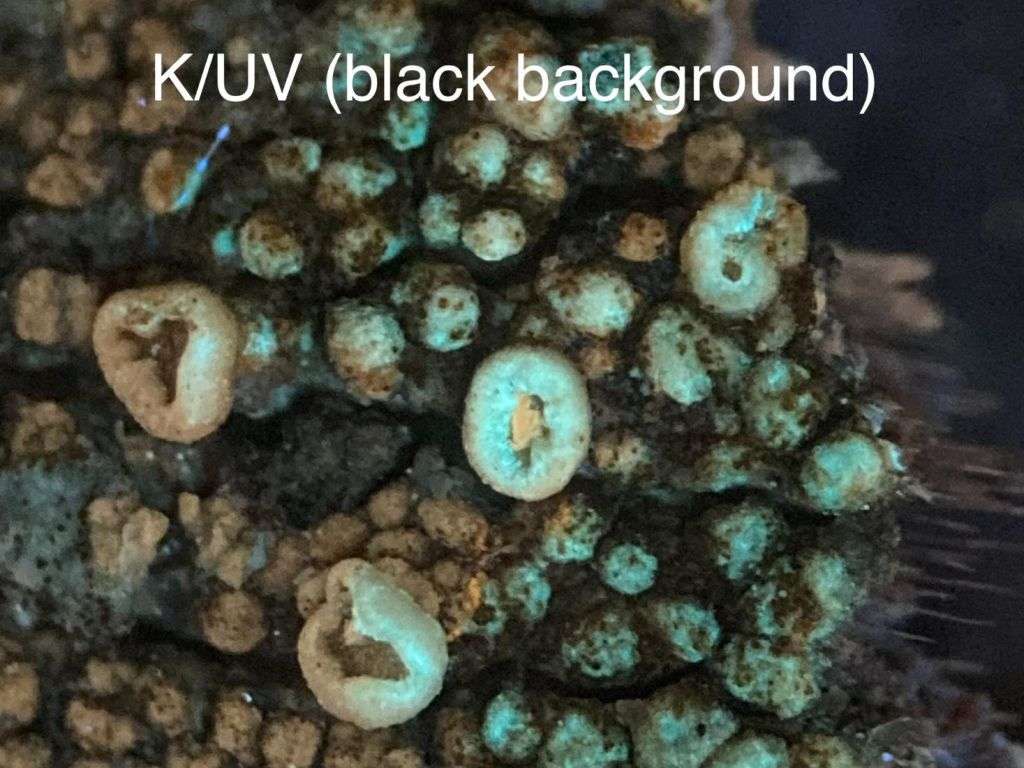
[attachment=0]FwGZ5B4XsAAquCT.jpeg[/attachment] I wonder whether some lichens/substances exhibit a K/UV reaction when fresh but not in herbarium specimens? Now I want to go and collect some fresh
Lecanactis abietinato compare any K/UV with my herbarium material. As for roccellic acid, I immediately dug out some specimens of
Fellhaera viridisorediataand failed to detect any K/UV reaction. Next day, I walked to a nearby wood where good, fertile F. viridisorediatagrows on rotting windblown spruce trunks and collected some fresh material. This also failed to give any hint of a K/UV reaction. So I doubt that roccellic acid exhibits any K/UV reaction in either fresh or herbarium specimens because roccellic acid is supposed to be the only major lichen substance in F. viridisorediataand is present in some quantity. As for whether K/UV reactions fade in old specimens, I have a little experience of testing herbarium material. The historic
Lecanora subfuscagroup specimens from Suffolk exhibited a varying degree of fading intensity of both their K+ yellow and their K/UV+ yellow. In most specimens from the interwar period (first half of twentieth century) atranorin could still be detected by the K+ yellow and K/UV+ yellow but both reactions seemed weaker than in more modern material. I have examined historic specimens containing confluentic acid (including Lecanographa lyncea) and the K/UV+ mauve remains quite intense. This leaves various issues unexplained but perhaps we should be more excited than frustrated to be investigating this interesting phenomenon.
June 7, 2023 at 9:20 am #45467Agree Mark David said after seeing this confusing K/UV+ blue on
Lecanactis abietinain the field he said he also failed to get the same result from herbarium species or on roccellic acid containg species from the herbarium. Also there is no obvious fluorescence after the spot on the Lecanactis abietinain field after it dried as well. Will have to see how confluentic acid spot behaves when it is dry. Dendrographa decolorans(unknown fatty acids) appears to give a fainter one than Syncesia myrticolam. sorediata, it would be more useful if it had none! Shame about the
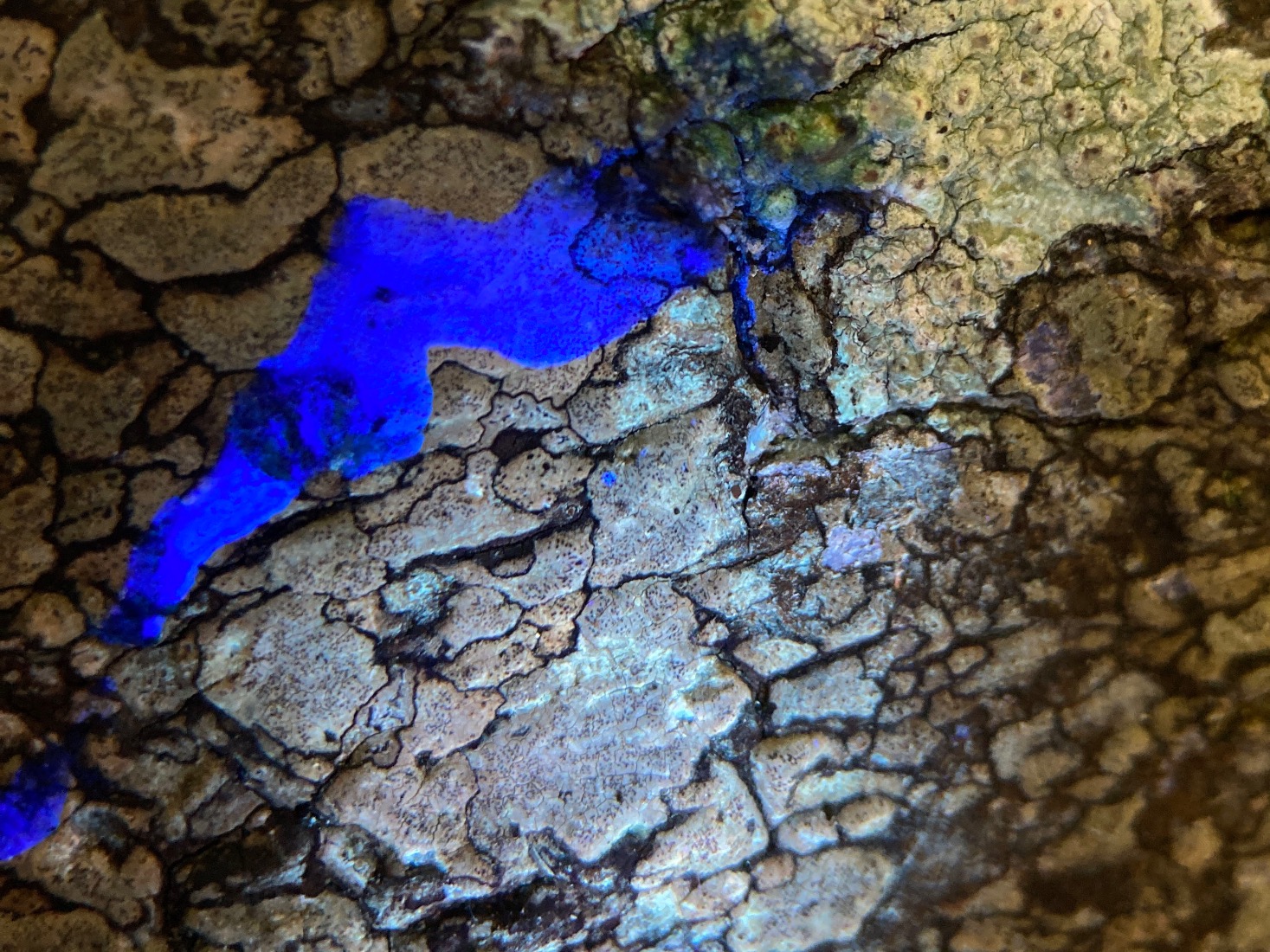
Fellhaera viridisorediata. A somewhat surreal photo of the K/UV test on the confluentic acid containing
Enterographa crassa: 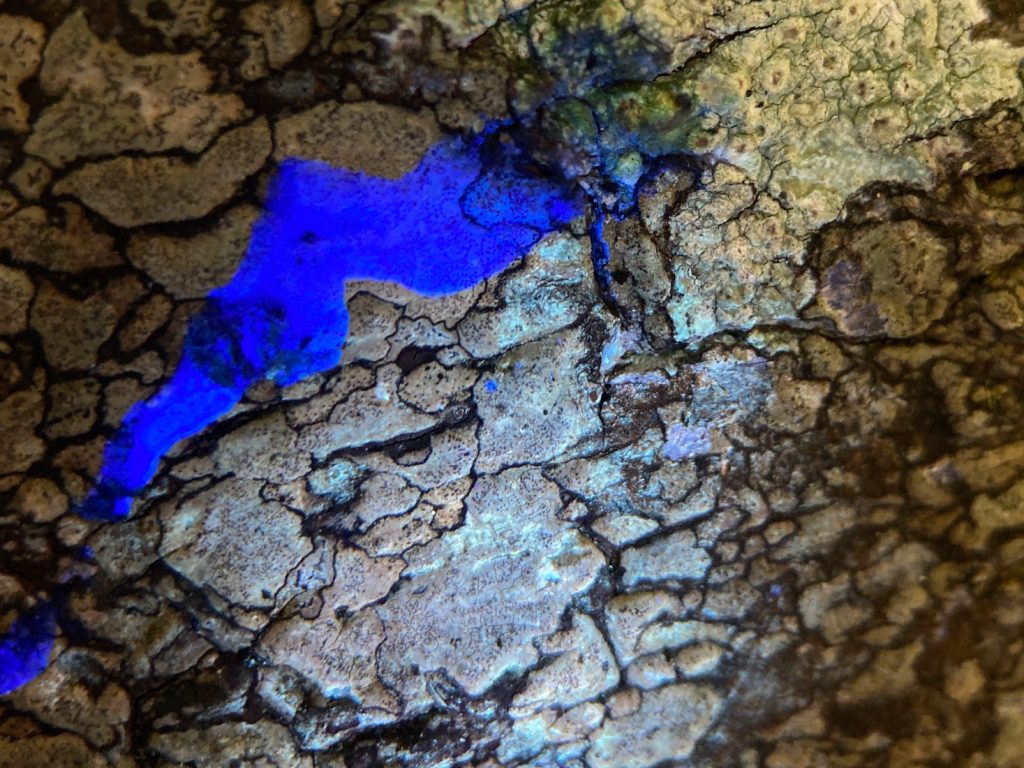
[attachment=0]IMG_2180.jpg[/attachment] Neil
June 8, 2023 at 1:57 pm #45468I collected some fresh Lecanactis abietinathis morning and found that it exhibits a distinct K/UV+ blue/mauve reaction. A specimen collected from the same tree in 2008 lacks any hint of a K/UV reaction. When I observed the K/UV+ mauve reaction in
Inoderma subabietinafor the first time several years ago, it is lucky that I compared my fresh specimen of that species with a herbarium specimen of L. abietina, otherwise I may have got confused and never drawn the link with confluentic acid. There appears to be a similar temporary K/UV reaction in
Lecanora varia, a K/UV+ turquoise discussed on twitter but not apparent in herbarium specimens. 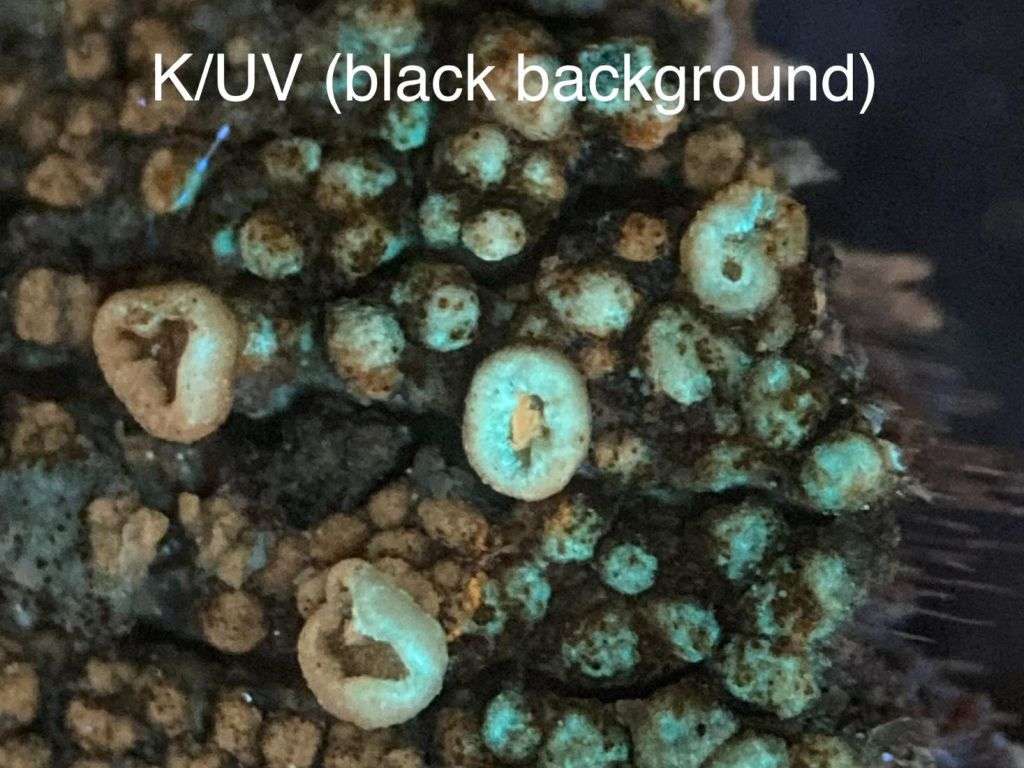
[attachment=0]FwGZ5B4XsAAquCT (1).jpeg[/attachment]
https://twitter.com/di_napier/status/1657775363563421698 So, we have an interesting and unexplained phenomenon, one which may cause confusion in some cases if it is not known about, and so far with unknown diagnostic value.
I will retain the specimen I collected today and test it periodically in an attempt to find out how long the ‘temporary’ K/UV reaction of
L. abietinalasts. Unfortunately the only local colony of L. variahas gone (along with so much quality lignum from the modern landscape) so I can’t experiment with that species. June 8, 2023 at 7:02 pm #45469Update about the K/UV reaction of my fresh specimen of Lecanactis abietina. Four hours after applying the K, the fluorescence of the spot had dulled to a pastel mauve and the centre of the spot had lost its fluorescence altogether, leaving a pastel yellow colour. Already there has been a change but a subdued K/UV+ mauve is still apparent. I will keep checking on the original spot from time to time and compare with freshly applied K. July 8, 2023 at 6:49 am #45470One month after collecting a fresh specimen of Lecanactis abietinaI have now tested its K/UV reaction again. When a spot of K is applied, and UV shone on it, the specimen still gives a rather intense K/UV+ mauve. In other words, a month after collection a specimen of L. abietinastill exhibits its ‘fresh’ reaction rather than the (lack of) reaction given by herbarium specimens. The original spots of K applied a month ago have almost completely lost any K/UV+ mauve reaction and instead the old spot site reflects a pastel yellow colour. However, this is of less importance because most people will be shining UV at newly applied spots of K, whatever the age of the specimen.
July 29, 2023 at 6:57 pm #45471Just been looking at what I thought might be Lecanora jamesii under the stereomike C- K- P-, sterile sorediate crust on dying juniper at Old Winchester Hill. Under UV the grey thallus and yellowish soredia are UV+ weak dirty orange, but my previously invisible spot of P stood out as pale yellow and my K as bright yellow. September 1, 2023 at 11:20 am #45472Thank you for the reports of reactions in a possible specimen of Lecanora jamesii. I would have replied sooner but I don’t have a specimen of L. jamesii to attempt to replicate your observations. It is useful to have your notes for future reference. September 1, 2023 at 11:48 am #45473Returning to my specimen of Lecanactis abietina collected on June 8th this year and I find that, almost three months later, the specimen is still producing a noticeable K/UV+ mauve reaction. In other words, three months after collection a specimen of L. abietina still exhibits its ‘fresh’ reaction rather than the (lack of) reaction given by herbarium specimens. December 12, 2023 at 10:09 am #45474An update on the K/UV reaction of my specimen of Lecanactis abietina which I collected six months ago (June 8th) and which I subsequently dried and incorporated into my herbarium. The specimen still exhibits a fairly intense version of its ‘fresh’ K/UV+ blue/mauve reaction. A specimen collected from the same colony in 2008 lacks any hint of a K/UV reaction. However it is worth noting that Neil S. has reported a faint reaction from a c20 year old specimen. -
AuthorPosts



- You must be logged in to reply to this topic.