
Lichenicolous perithecia on Myriolecis (Lecanora) albescens
- This topic is empty.
-
AuthorPosts
-
March 10, 2023 at 8:01 pm #32577

[attachment=2]IMG_7781.jpg[/attachment] (Some of these photos were previously posted on the “Lichenicolous fungi 2.0” Facebook group.) The host lichen is what appears to be Lecanora (Myriolecis) albescens, although the apothecia show some K+ y reaction, and there is a distinct UV green fluorescence on the apothecial rims (posted on Twitter – there are references to the green fluorescence in the literature). The perithecia were noticed when investigating the fluorescence.There are black perithecia (and perhaps some pycnidia?) on top of the host, about 0.1 to 0.3 mm diameter. The spores are dark brown, and almost all are 3-septate. Found abundantly on concrete paving (wall tops) in a rural Warwickshire garden. mm squares

[attachment=8]IMG_7741-1.jpg[/attachment] 
[attachment=7]IMG_7742-1.jpg[/attachment] In the Facebook group, Paul Diederich responded “probably Phaeospora lecanorae. Measure the spores to be sure.”
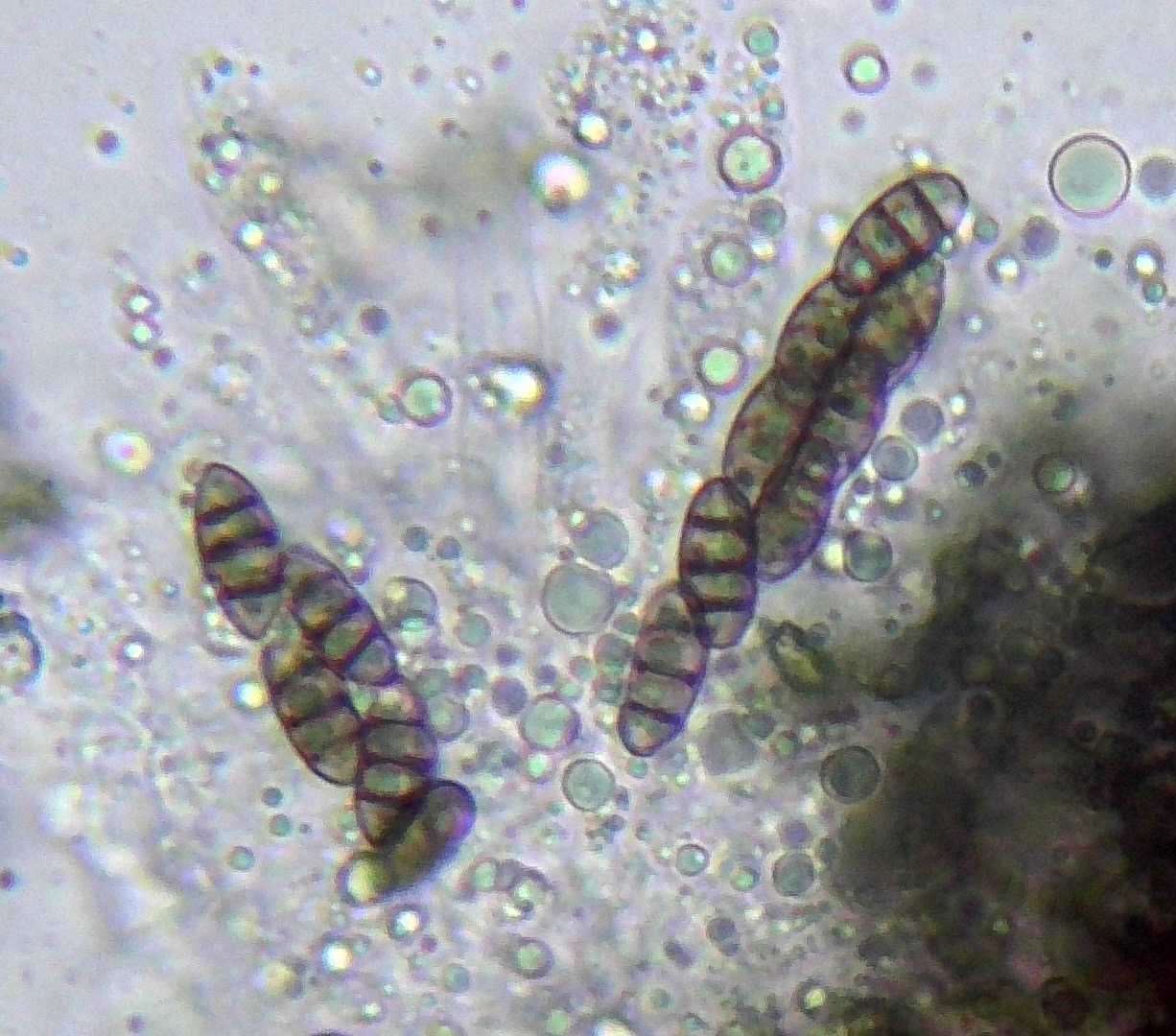
Abuot 20 spores averaged c 14.5 um (12.5-16) x 6.5 (5.5-7). The length matches the Phaeospora lecanorae description in this paper online, although some are slightly wider.
[attachment=6]IMG_5731.jpg[/attachment]
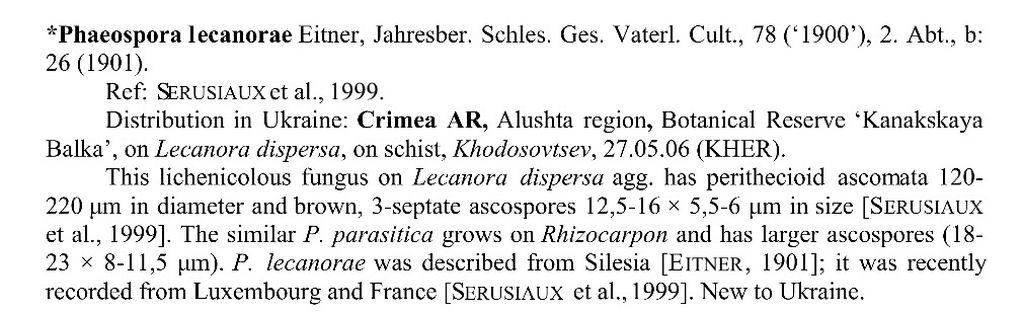
This reference is from “New lichenized and lichenicolous fungi for the Crimean peninsula (Ukraine)” October 2007. It refers to the host being Lecanora dispersa agg. (Was L albescens included then?) Spore size is quoted as 12.5-16 x 5.5-6 um.
[attachment=5]IMG_7755-1.jpg[/attachment] 
[attachment=4]IMG_7759-1.jpg[/attachment] 
[attachment=3]20230309211854280.jpg[/attachment] 
[attachment=1]0026.jpg[/attachment] 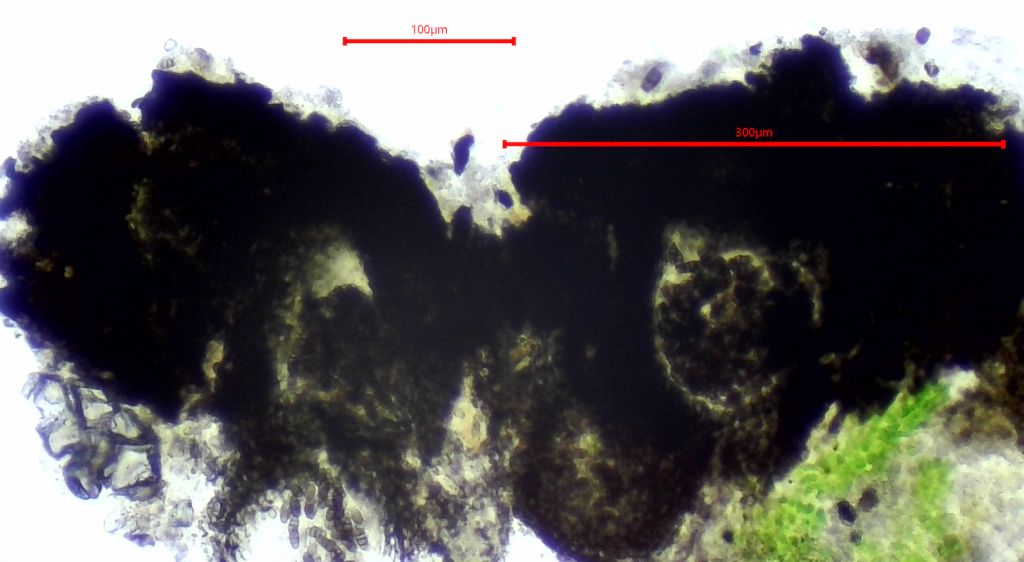
[attachment=0]Screen Shot 2023-03-10 at 19.34.43.png[/attachment] March 11, 2023 at 3:25 pm #45355If Paul D identified this as Phaeospora lecanoraeI wouldn’t question the ID – the spore size is quite near enough, I think. Lecanora dispersais also now a Myriolecisso the host is OK for this species. The world lichenicolous list gives the host as Lecanoraand Myriolecis, but I don’t know whether the Lecanorarecords are historical for species now placed in Myriolecis. As far as I can tell this hasn’t been reported for GBI before, so it would be useful to send this info on to Brian Coppins (and also a specimen if you have sufficient).
Best wishes
Paul
March 11, 2023 at 4:40 pm #45356I was pleased to see details of this putative/probable Phaeospora lecanoraeposted here and endorse Paul Cannon’s suggestion. If Paul D. thinks it is the closest match then I think it is worth going with that suggestion, running it by Brian Coppins and, unless he has hesitation (I doubt he will) claiming P. lecanoraeas new to Britain. In this twitter thread I explain how my confidence was boosted in my suspicion of
Acarospora versicolorand how I added it to the British list: https://twitter.com/obfuscans3/status/1369957066455023617 It is not a total disaster if a taxon gets added to the British list and we subsequently find out it is something else. It has happened many times before. As just one example British material of
Caloplaca marmoratawere previously called C. lacteauntil Czech lichenologists helped me with the taxonomy of this species. We try hard to verify our identifications but sometimes we can be over-cautious. If we didn’t accept your specimen as Phaeospora lecanorae, the alternative would be to put it unnamed (or only named to putative genus) into the database (with a brief description) and this may make it more difficult for people to refer to your occurrence in future. My intuition would be to add it to the British list as P.lecanoraebut Brian’s opinion will be far more important than mine. If you need any further help with this, do contact Paul or me as it is well worth pursuing.
Mark
March 11, 2023 at 4:49 pm #45357Thank you both. That’s great. Yes, I’m happy to send a specimen. March 11, 2023 at 4:52 pm #45358I added an arguably more contentious lichenicolous fungus to the British list, Cladosporium licheniphilum: https://fungi.myspecies.info/all-fungi/cladosporium-licheniphilum Again it was a suggestion by Paul Diederich, and from memory a less definite endorsement by him than for the
Phaeosporalecanorae. Paul Cannon by contrast, reasonably suggested that it might just be a generalist saprobe. In discussion with Brian Coppins, and having found it on Xanthoria parietinaseveral times, we decided to add it to the British list. The true identity of this hyphomycete that occasionally turns up on X. parietinais almost certainly still in doubt but we now recognise it as an entity, have a description of it available and can submit records of it to the database. If we are calling it by the wrong name it won’t be a disaster. The BLS database would be amended to reflect any new insights. March 12, 2023 at 7:28 pm #45359Good news and congratulations. Phaeospora lecanoraehas been accepted as new to Britain & Ireland. People who know me may guess how pleased I am when such an interesting discovery is made in a domestic garden. I’m not sure that my ‘book’ will ever be finished, nor published, but work continues and the short introduction stresses the value of studying the lichens close to home:
March 12, 2023 at 8:29 pm #45360All the information shared on Twitter is a fantastic resource, used by many, and easily searchable, but if Twitter breaks (and it has had quite a few significant disruptions recently) so much really useful information could suddenly no longer be available. That would be a great loss. Here’s hoping that the book, (or maybe a website that can be added to in increments?), will become available at some point not too far off. ‘New’ species are perhaps less important than knowing more detail about familiar species really, and the encouragement to look closely, and all the remote-tutoring via Twitter on microscopy has been so valuable. Thank you
March 12, 2023 at 10:17 pm #45361Congratulations Chalkie on adding Phaeospora lecanorae to the lichenicolous list for GB&I. Yes, completely agree with your comments (and find Twitter thoroughly frustrating) – all Marks information and posts collected into a website would be an incredibly useful resource!
-
AuthorPosts



- You must be logged in to reply to this topic.