- This topic is empty.
-
AuthorPosts
-
December 6, 2022 at 9:52 pm #32517
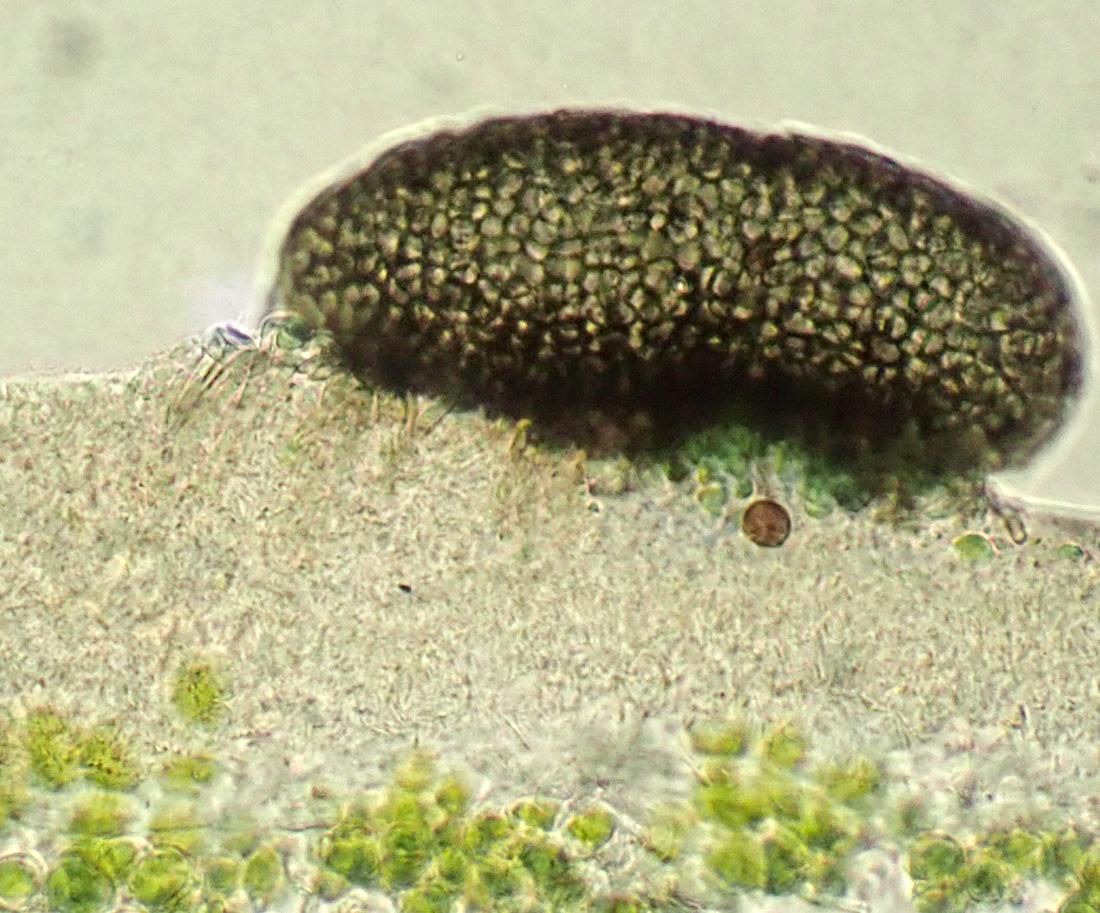
We collected some lichens on twigs from north Devon for a teaching day. Looking at them later we noticed that one of the Ramalina fastigiata thalli bore small dark discs which at first we assumed were the discocarps of a lichenicolous fungus. However, when we examined these button-like growths in more detail we were surprised at what we found. 
[attachment=6]Ram fastigiata Barnstaple small.jpg[/attachment] 
[attachment=5]On Ram fastigiata Barnstaple (2) small.jpg[/attachment] 
[attachment=4]On Ram fastigiata Barnstaple (9) small.jpg[/attachment] 
[attachment=3]On Ram fastigiata Barnstaple (6) small.jpg[/attachment]
Squashes of the growths showed that the interior is a closely packed mass of cells (cyanobacteria) in gelatinous sheaths, about 15 to 20 microns diameter (including the sheath). The dark parenchyma-like casing is clearly seen as are attachment hyphae, and there are also some finer hyphae present. No conidia or spores of any kind could be seen.
[attachment=1]On Ram fastigiata Barnstaple squash unstained small.jpg[/attachment] 
[attachment=0]On Ram fastigiata Barnstaple squash small.jpg[/attachment]
We are very interested to hear if anyone recognises this sort of growth. Any thoughts gratefully received!December 6, 2022 at 10:06 pm #45193I wonder if this organism is parasitising the Ramalina or using it as substrate only? The hyphae coming from the underside appear septate and are extending into the lichen cortex but the lichen shows no ill effects. As this organism seems to contain both algae and hyphae could this be the smallest lichen ever? Lichenicolous lichens certainly exist. December 7, 2022 at 1:53 pm #45194Maxine recently found something similar – see the post Possible commensal association between a cyanobacterium and Lecidella elaeochromaon this forum earlier this year. We also briefly discussed similar structures in our recent paper describing the new genus Gilbertaria< https://link.springer.com/article/10.1007/s11557-022-01838-5 Alan
-
AuthorPosts




- You must be logged in to reply to this topic.