Forums › Forums › Fungi ID requests (post here if you aren’t sure what type of fungus you’ve found) › Small red spherical fungus.
- This topic is empty.
-
AuthorPosts
-
October 15, 2021 at 9:39 pm #32191
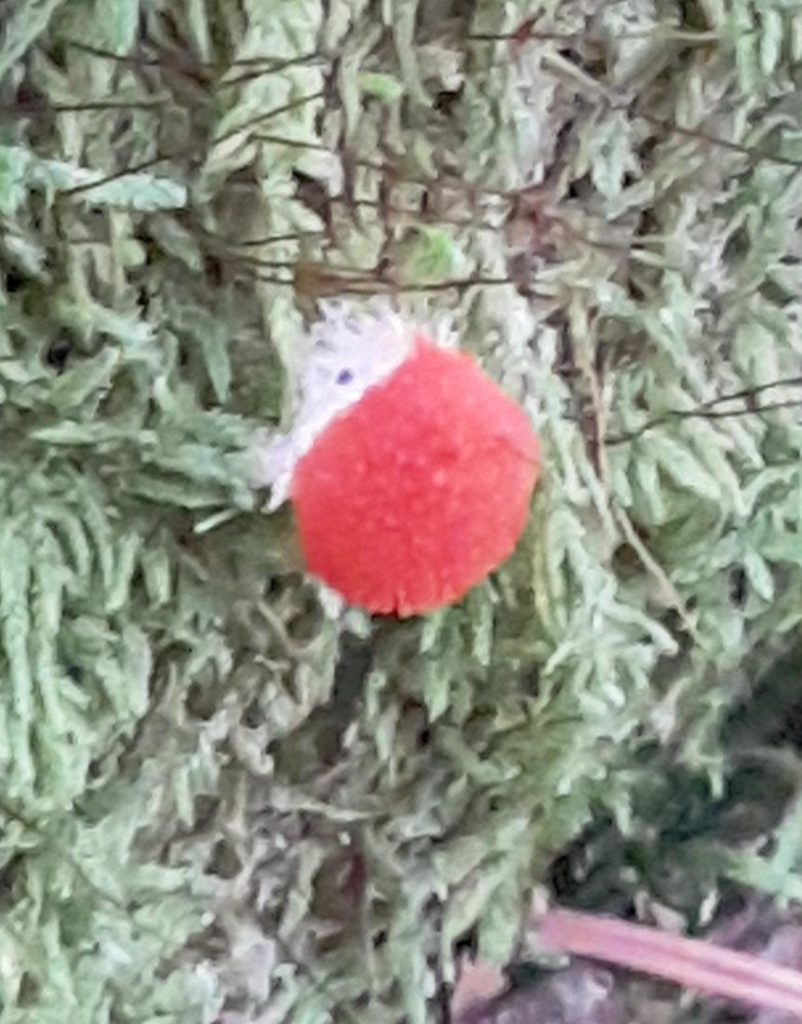
[attachment=0]Fungus1.jpg[/attachment] This is one fungus of three I found, widely spaced, on a rotting Scots pine by a lakeside in the Lake District in mid October. A lightly shaded area out of full sun.
Sphere is about 8mm diameter and had a rough dry texture. Slightly resilient, like a stiff rubber.
Closest match I could find is a fruiting body of a wolf’s milk slime mould, but this definitely did not feel fluid filled.
Can anyone help me with an ID?
I also found a perfect yellow stagshorn (thank you Google lens) on the same trunk.
October 16, 2021 at 2:35 pm #44368Hi, and welcome to UK Fungi. This has the general looks of a small example of
Tubulifera arachnoidea, which is a myxomycete (Slime Mould). But I would have expected that to be quite soft at this stage, rather than rough, dry, and slightly resilient as you mention?
Regards,
Mike.
October 16, 2021 at 3:54 pm #44369Thanks Mike. ‘Arachnoidea’ from the spider-like extrusions I assume.
Definitely resilient, very like one of those small jelly fruit sweets. Jelly tots?
Also, it was in that clump of lichen on the brighter side of the log with no obvious crevice it could have come from, whereas I believe slime moulds seek out the dark, dank places.
Apart from the texture, it does resemble the raspberry slime mould though.
October 16, 2021 at 4:52 pm #44370Are you sure it’s not Tubifera ferruginosa . looks a bit Raspberryish but difficult to determine from the fuzzy picture as to what the shape of the tips is. October 16, 2021 at 6:16 pm #44371Sorry about the blurred pic but I can’t provide any more detail. I wish I’d spent more time studying it carefully but light was going and we still had a good distance back to the car. Should have used flash! If ‘Lancashire Lad’ is anywhere near Derwent Water and wants to take a look I can locate it exactly
😀 Kicking myself if it is a slime mould as I’ve been looking for them as the fan shaped structures inside rotting wood rather than the fruiting bodies in plain sight.
October 16, 2021 at 7:52 pm #44372Ironic given the most likely ones you’ll see are 1 dog vomit which is a large yellow mass
2 false puffball which is a pearly white blob on rotting trunks with brown marks if the outer layer is damaged
3 Wolfs milk which are small, though quite large for slime moulds, spheres of varying colours through brown, pink , orange etc
I’ve seen raspberry a couple of times, stemmed types like stemonitis a couple of times and one of the fanned variety only once.
October 16, 2021 at 8:57 pm #44373Live and learn . . . Live and learn. Thanks all.
October 17, 2021 at 11:21 am #44374irturner wrote:
Are you sure it’s not Tubifera ferruginosa . . . .
Same thing! –Tubifera ferruginosawas the previous name for Tubulifera arachnoidea
The only other potential suspect – which would fit the provided “rough, dry, and slightly resilient” description better, would be
Illiosporiopsis christiansenii, which is a small bright pink lichenecolous fungus (i.e grows directly on lichens – particularly Physciaspecies) although at 8mm diameter, your example would be extremely large for an Illiosporiopsis christianseniifruitbody. (Usually only up to about 2mm max.) Other than those two suggestions, I’m at a loss as to what it could be.
PS – I’m quite some distance away from Derwentwater.
Regards,
Mike.
October 17, 2021 at 9:23 pm #44375Ha one lives and learns. Mind you one of the benefits of the English names is that they usually stay the same, Judas ears aside, while the classifications get moved around as they change their minds over which grouping they belong to. October 18, 2021 at 12:46 am #44376It’s the perfect colour for Illosporiopsis christianseniibut the substrate is wrong. What is it? It looks a like washed-out pleurocarpus moss. And as Mike says it’s far too big – see: http://www.ascofrance.com/search_recolte/3333http://www.ascofrance.com/search_recolte/3333” class=”bbcode_url”> With regard to English names, one big problem is that they reverse the very useful Linnaean system – so if you list
Agaricus langeiby scientific name it becomes a member of a group called “Agaricus” a chance to compare it with other Agaricusspecies which are all closely related. If you list it by English name what does that tell you? If you list it by “scaly” you get fungi which are not in any way related. OK “scaly wood mushroom” – what does that tell you? It’s a mushroom . . . we kind of worked that out – it’s a wood mushroom . . . so a mushroom that grows in woods, that narrows it down 🙄 It’s ascalymushroom, but “scaly appears all over the place in these English names – Pholiotaspecies are “scaly caps” apparently; but only 7 Pholiotaspecies appear in the list as “scaly caps” so where does that leave the other 35 or so Pholiotaspecies without an English name? These English names only confuse things, I would contend that they do not actually make things easier for beginners, they imply that naming a fungus, especially an agaric is always easy. They were designed to make things easier for politicians and other decision makers to engage with in order that fungi might play a part in those decisions. If anyone has any information about how successful that has been I would be interested.
Fungi are crucial to the running of the planet – they were key in life moving from the oceans to dry land. We need to get that message across rather than worry about creating more names for them.
rant over
Chris
October 18, 2021 at 8:43 am #44377I agree with Chris about the Linnean system being much better than English names but with the advent of cheap DNA sequencing these names do change and that gets a bit annoying and puts some people off fungi. I just looked at Boertmannn’s “The Genus Hygrocybe” 2nd edition 2010 and a lot of them aren’t hygrocybe anymore.
Whereas waxcap does cover them in the main.
Hopefully the names will eventually settle down as more sequencing is done and more family trees are produced.
There’s also the problem of the pronunciation of Latin names and the fact that as I get older I can’t always remember them .
That’s the fun of fungi ,of course.
October 18, 2021 at 8:54 am #44378Thinking on from my original post, I said semi shaded but the leaf cover was quite high here and the day I spotted it the weather was particularly sunny all day (last Thursday). Is it was exposed to direct sunlight is it possible that would harden the outer membrane of tubulifera arachnoidea which it’s what it most resembles?
Unfortunately the little beast is about a 2 1/2 hour trip to revisit (if it’s still there) and we’re heading south to go home tomorrow.
-
AuthorPosts



- You must be logged in to reply to this topic.