
Verrucaria from Denmark
- This topic is empty.
-
AuthorPosts
-
March 11, 2021 at 1:31 pm #32060
This specimen was found growing on a fist-sized fragment of concrete lying on the forest floor in a rather closed canopy forest. I have landed somewhere in the “murina-group” and I am having a hard time deciding on the correct ID. I have measured 15 spores, which average to 17.43 x 7 µm – the smallest spores I found were ~15 µm long and the longest; 22 µm. This is within the range of several species, but perhaps too large for V. dolosa (which was my working hypothesis based on morphology. The thallus is very thin, film-like and does not appear completely restricted to the concrete, as it spreads onto larger siliceous pebbles in the matrix. The seemingly bullate structure of the thallus is a consequence of the structure of the concrete – the thallus is filmy throughout. I have attempted to get a complete section of a perithecium, but the very thin thallus makes this a frustratingly difficult task. Any comments or suggestions that can help move me closer to a definite ID are more than welcome. 
[attachment=0]Verrucaria sp. #3.jpg[/attachment] 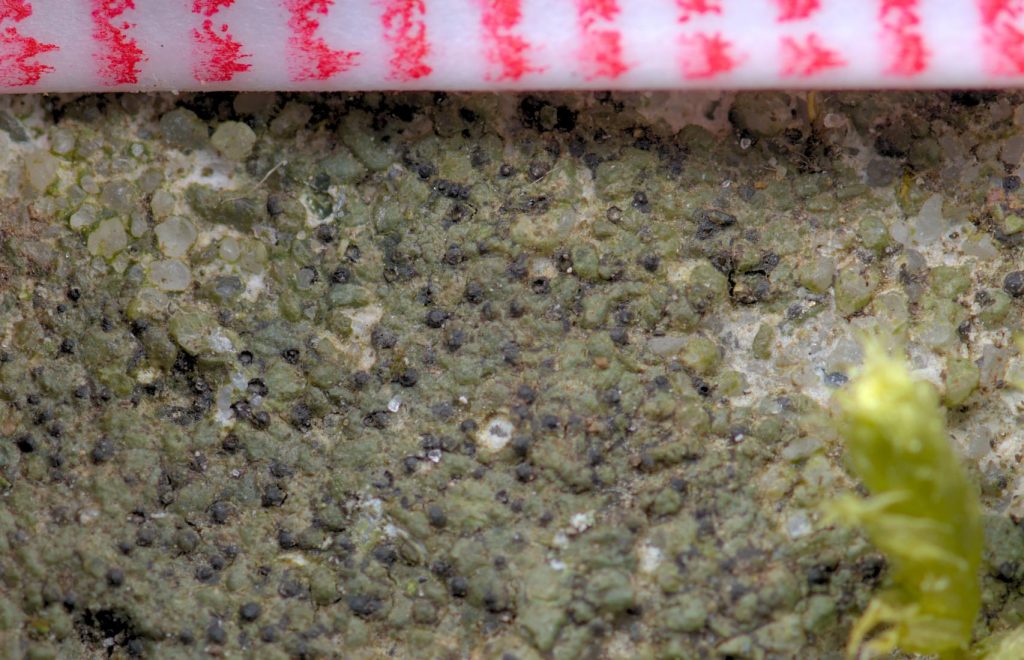
[attachment=1]Verrucaria sp. #3 (målebånd).jpg[/attachment] 
[attachment=8]Verrucaria sp. #3 section 1.jpg[/attachment] 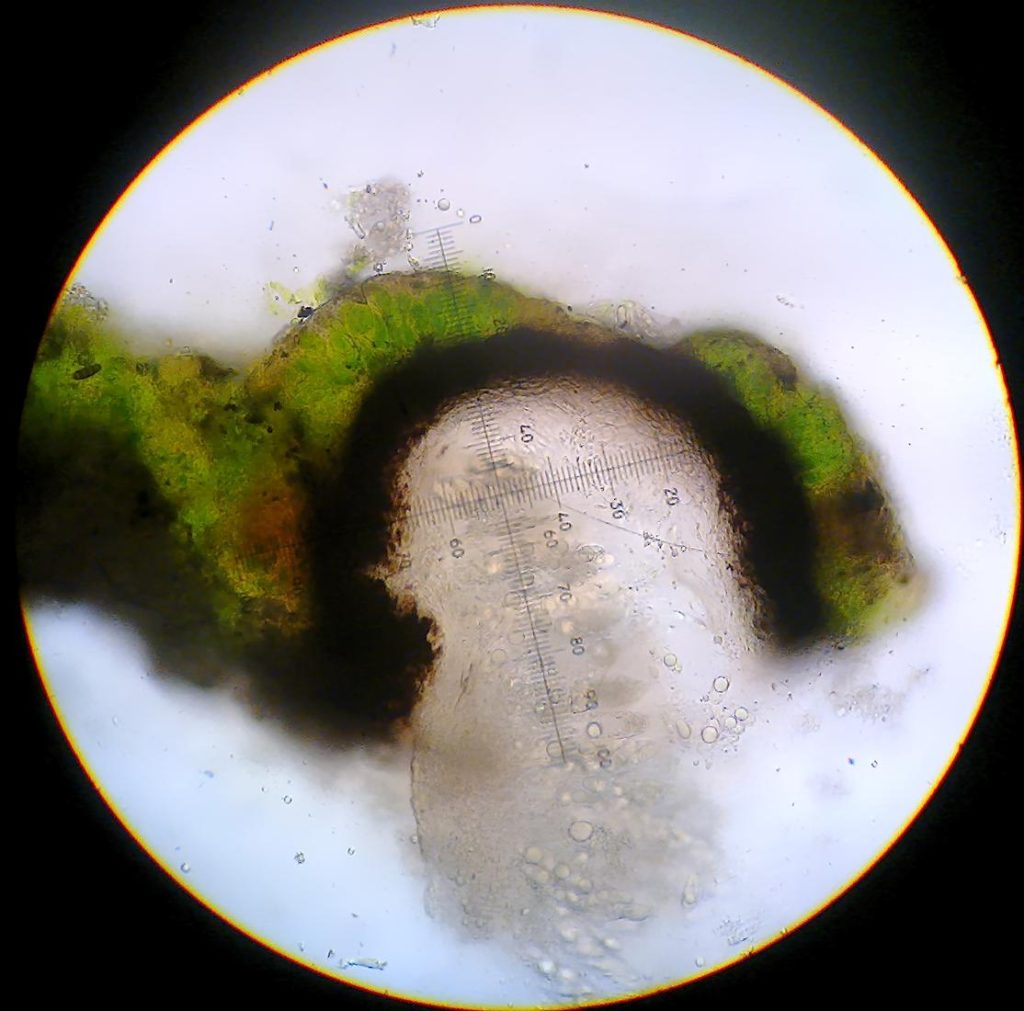
[attachment=7]Verrucaria sp. #3 section 2.jpg[/attachment] 
[attachment=6]Verrucaria sp. #3 section 3.jpg[/attachment] 
[attachment=5]Verrucaria sp. #3 section 4.jpg[/attachment] 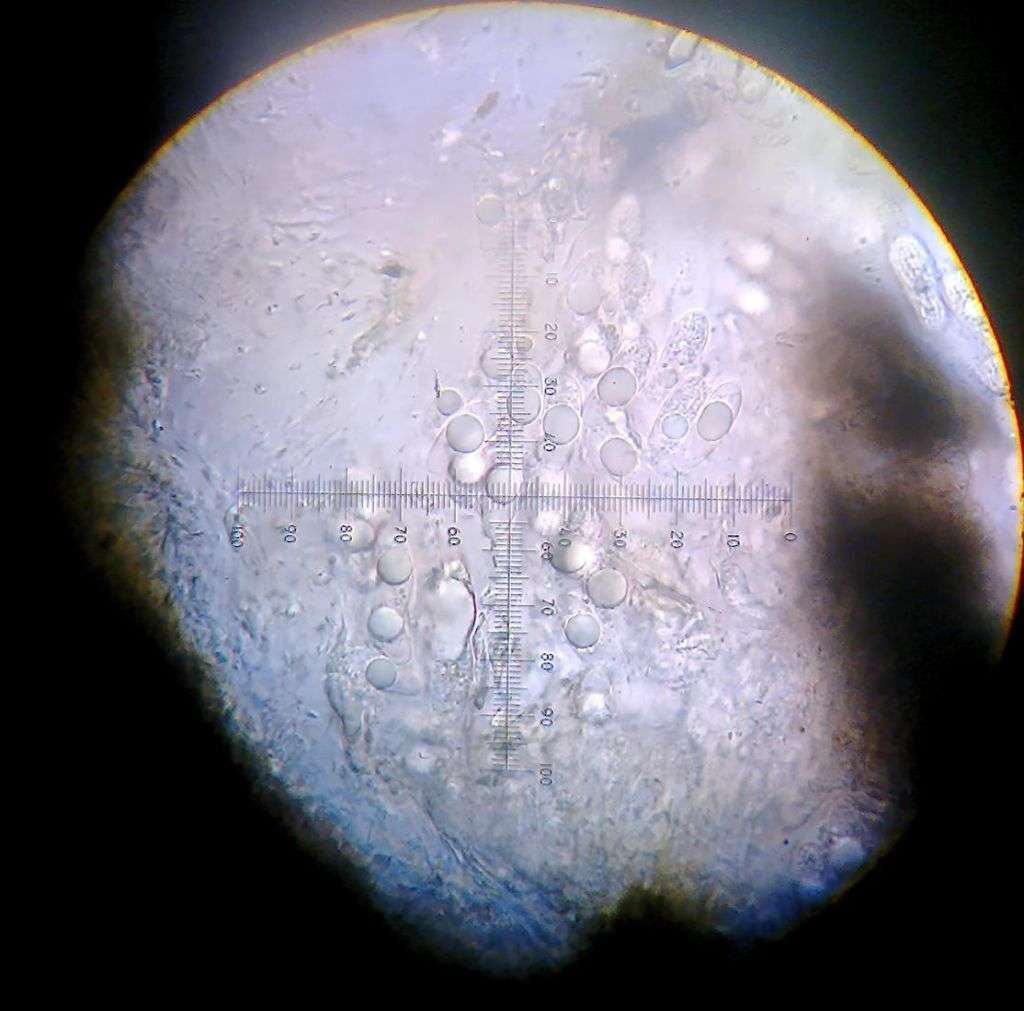
[attachment=3]Verrucaria sp. #3 spores 2.jpg[/attachment] 
[attachment=2]Verrucaria sp. #3 spores.jpg[/attachment] 
[attachment=4]Verrucaria sp. #3 spore (large) 2.jpg[/attachment] March 12, 2021 at 5:04 pm #44073This might well be one of the bewildering, poorly understood taxa that have features similar to, and often intermediate between, V. dolosaand V. murina. In which case I probably can’t offer much help as I have many of my own collections of such things awaiting identification. It is useful that you mentioned that the thallus morphology is film like and highly affected by the bullate nature of the underlying substratum. I wonder if you have considered V. elaeinawhich is rather common on fragments of rock, including concrete, in moderately shaded situations close to the ground? I’m afraid that these little Verrucariaspecimens are very difficult, often suppressed and/or browsed, and with lots of poorly understood or unknown taxa as possibilities. Sometimes I compare with good material of known species and decide whether it is or isn’t the same thing. Many times I am unable to make a decision. I’m sorry this reply makes it all sound so difficult. If I have any flashes of inspiration I will respond further but for the moment I will leave you with a link where you will find images of V. elaeina: http://fungi.myspecies.info/taxonomy/term/7671/media March 15, 2021 at 10:46 am #44074I suspected that it was not a crystal clear case – it rarely is with Verrucaria spp.in my experience, however limited it still is. Thank you for the link, it is a great site that I have used frequently for the high quality microscopy images of quite a large number of taxa. I have considered
V. elaeinaand it is not a bad fit in terms of spore-size, but I am not sure that the shape of the spores is right. According to LGBI, V. elaeinahas ellipsoid spores whereas the spores in my specimen have a +/- distinct taper towards one end and instead appear +/- sole-shaped. This tapering is mentioned for V. dolosain LGBI, but I am unsure how common this shape is in Verrucariaand if it should be considered as evidence for V. dolosa. What do you think? March 15, 2021 at 12:54 pm #44075Unfortunately I can’t answer your question about whether the tapering of the ascospores mentioned for V. dolosais in any way diagnostic. I am very glad that you have raised the subject though. It is always difficult to know whether such observations have been made in reference to other similar species or whether it is a comment that has been lifted from a previous publication which was only considering the one species. The following website conveniently has micrographs of V. dolosaand V. elaeinaascospores. I am not very familiar with the website but I have no reason to doubt its integrity. https://waarneming.nl/taxa/15233/?genus=Verrucaria I am not sure that I can detect a great difference in shape but perhaps those of
V. dolosaare slightly more tapering. Perhaps this will stimulate me to dig out specimens of both Verrucariaspecies and look at the ascospores with their shape specifically in mind. I am approaching this with a slight scepticism that the shape of the ascospores in V. dolosais particularly diagnostic but keeping a very open mind. Even if we aren’t making much progress with identifying your specimen, I am pleased that this discussion is taking place. The following micrograph from the lichens maritimes website (
http://www.lichensmaritimes.org/index.php?task=fiche&lichen=1084 V. elaeina. 
[attachment=0]Screenshot 2021-03-15 at 12.50.35 PM.png[/attachment] -
AuthorPosts


- You must be logged in to reply to this topic.