Forums › Forums › Myxomycetes (slime moulds) › Is this Diderma?
- This topic is empty.
-
AuthorPosts
-
July 26, 2016 at 1:45 pm #30256
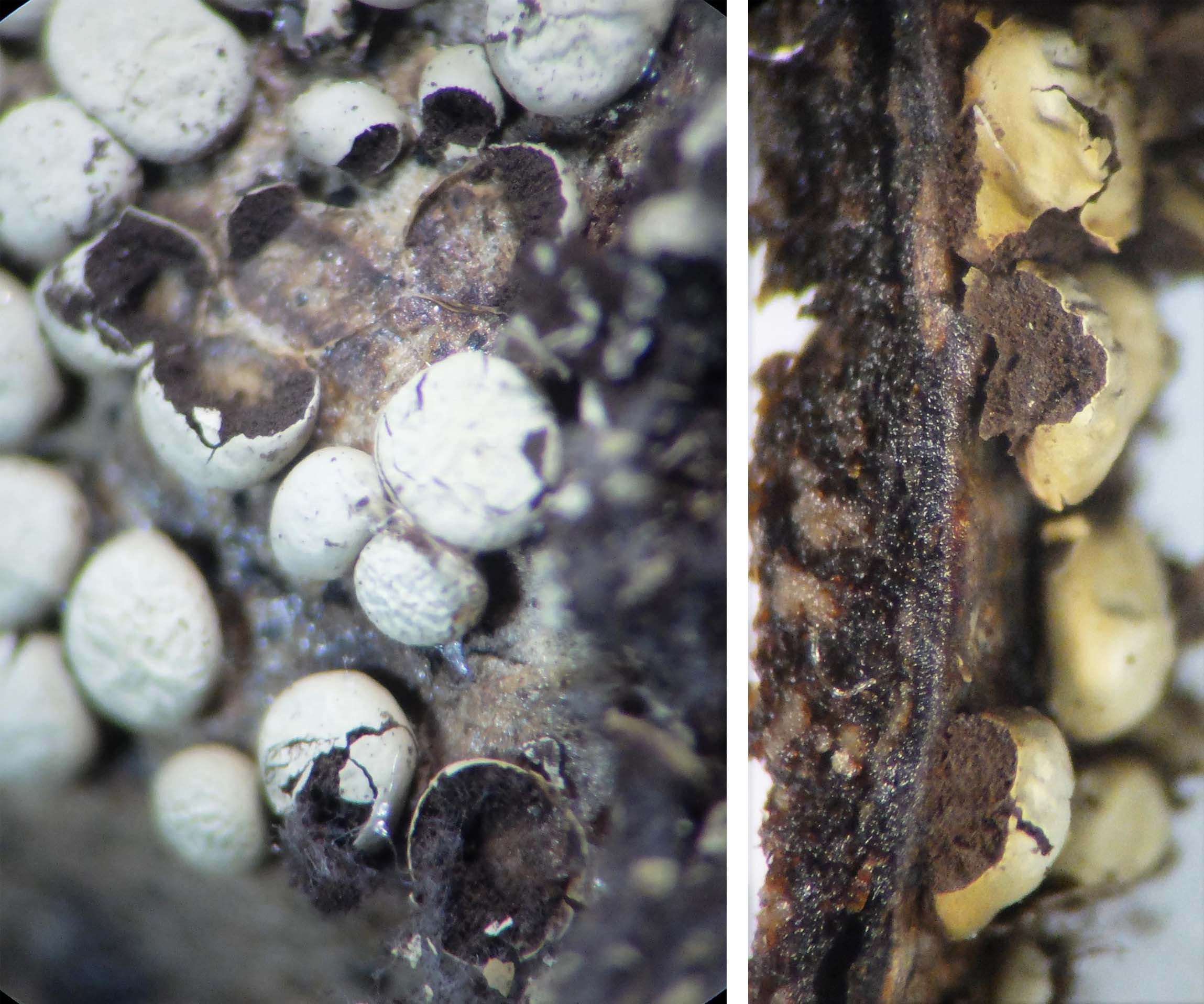
Hi, We found this myxo on a pine (probably) log. It is completely sessile, clustered, possibly on a hypothallus. The colour changed from grey to whitish on drying. Each sporangium was just under 1mm diameter. There was no evidence of a columella or pseudocolumella. The spores were 7.5-9, dark brown, verrucose. Capillitium was found in some sporangia – in others it was apparently not present. It was simple, about 1.25 um wide, and very finely roughened (oil immersion). The peridium was smooth, but effervescence occurred on applying dilute acid, suggesting the presence of lime. The opening was by irregular tearing. It appeared to be just a single layer.
My only book is Stephenson and Stempen’s “Myxomycetes: A Handbook of Slime Molds”. Using the key I got to Order Physarales. Only Diderma looked similar, but there is insufficent information to go any further.
Can anyone help me with this one as I am waiting for the big French Myxo book as a Christmas present

Cheers,
Steve

[attachment=5]1 Field.JPG[/attachment] 
[attachment=4]2 Stereo x45.JPG[/attachment] 
[attachment=3]3 Fresh and dried.jpg[/attachment] 
[attachment=2]4 Lime and Hypothallus.jpg[/attachment] 
[attachment=1]5 Structure.jpg[/attachment] 
[attachment=0]6 Microscopy.jpg[/attachment] July 26, 2016 at 10:20 pm #38535Hi Steve Order Physarales looks correct.
I think you need to squash a small piece of perideum in water and see if the lime is crystalline (i.e fragments of the perideum look star-shaped) or small round granules. It looks like the latter from your photos but you might want to double check.
If so, given the type of capillitium, I think this would put you in Diderma territory. Irregular dehesence and lack of banding on the spores might put you in the area of Diderma spumarioides (however I found one of these recently and it doesn’t look quite right and spores are bigger
http://nefsg.co.uk/diderma-spumarioides ).Diderma cinereum might be worth investigating (although this is rare in Britain according to Ing, so unlikely). There is a columella mentioned in the description but they are not always easy to observe.
If you can dry and store some samples, I’d be happy to have a look and pass on a sample for confirmation.
Cheers,
John
July 27, 2016 at 9:01 am #38536Hi John, Many thanks for the help. The peridium doesn’t seem to have crystals of lime.
I have a specimen which I would be very pleased to pass on to you. If my GPS is accurate enough (it is not so good in woodland) then I’ll try to locate the specimen again on Thursday. I accidentally dried this one along with specimens of crust fungi in the fruit dryer at 40 deg C – is this OK for preserving Myxos?
Cheers,
Steve
July 27, 2016 at 9:26 am #38537Hi Steve Yes, the picture fits the “amorphous granules” type.
I will pm you my address. A good way to store myxos is to UHU glue them to a piece of card cut to approx 1 cm longer than a matchbox. Fold up the ends of the card slightly (this keeps it nice and stable inside) and place in a matchbox.
40 C is probably fine for preservation (although the spores may no longer be viable).
Cheers,
John
July 27, 2016 at 10:14 am #38538Thanks John, I must find a matchbox!
Steve
July 29, 2016 at 1:43 pm #38539Thanks Steve, beautifully packaged.  July 30, 2016 at 9:00 pm #38540
Hi Steve The perideum was more ochraceous than I was expecting from the photos.
I think Diderma donkii may be an option. If so, it is uncommon. It is more normally found on leaf litter.
D. donkii spores are 7-8.5 (9) according to Poulain and 8-10 um according to Ing, so that fits OK.
Could you give me the collection location and your details and I will pass them on and get the record confirmed at the end of September?
Kind regards,
John
P.S. I was going to pm you an attachment but not sure if it is possible. Could you send me your email address and I will forward it on to you?
July 31, 2016 at 6:19 pm #38541Thanks John, Will do ASAP ie tomorrow (been walking in the Peak today, botanising with ‘t missis),
Steve
-
AuthorPosts




- You must be logged in to reply to this topic.