Forums › Forums › Fungi on miscellaneous substrates (not soil or wood) › Marine Fungi
- This topic is empty.
-
AuthorPosts
-
March 17, 2016 at 9:19 pm #30150
As most of us know fungi have exploited virtually all the possible biotopes – Hormoconis resinaethe fungus which can live in aeroplane fuel tanks threatened the Concordeproject 😯 So there are plenty of fungi associated with the marine environment, from shoreline sand-dunes to the open sea. My old Yorkshire mycological mate Jerry Cooper (now doing excellent work in New Zealand) sums up the situation extremely well here:
http://www.funnz.org.nz/sites/default/files/MycNotes6-MarineFungi.pdf ” class=”bbcode_url”> http://www.funnz.org.nz/sites/default/files/MycNotes6-MarineFungi.pdf A Northern Hemisphere equivalent to his
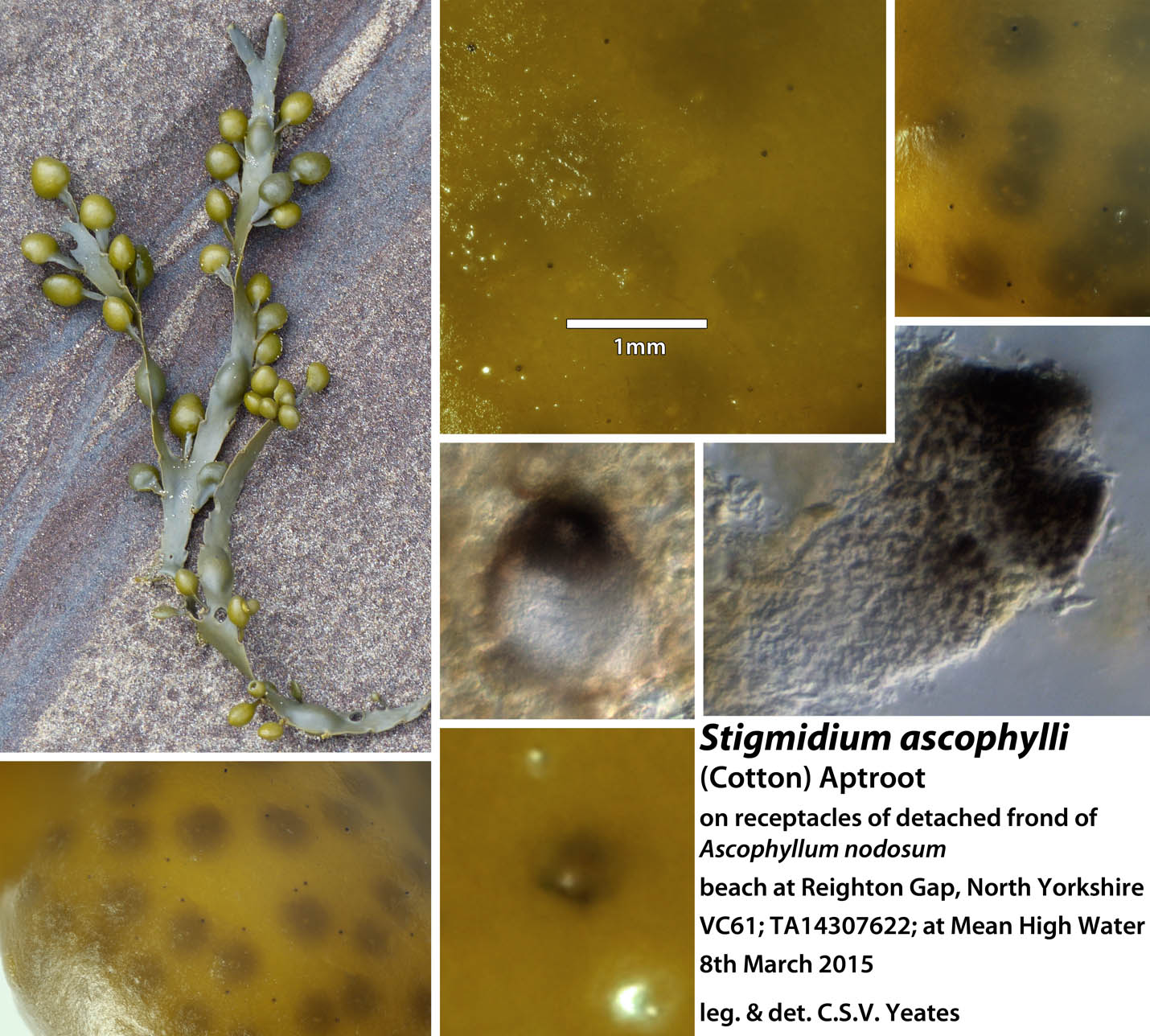
Stigmidium apophlaeaeis Stigmidium(formerly Mycosphaerella) ascophylli. Every time I have picked up a piece of knotted wrack Ascophyllum nodosumbearing receptacles the fungus is there; it is also found on channelled wrack Pelvetia canaliculata, though I have yet to look for it on that, similarly common, seaweed. More info is available here: http://www.lichens.lastdragon.org/faq/whatisalichen.html ” class=”bbcode_url”> http://www.lichens.lastdragon.org/faq/whatisalichen.html Here is a recent collection (a bit too early for mature ascospores to have formed, though they do tend to be expelled as soon as they ripen and so are easily missed. Next time you’re at the seaside have a (close) look for it – those tiny black dots are the perithecia. This
hasbeen recorded for Dorset Jenny – in fact I think that Cotton’s type collection may well have been from there . . . Chris
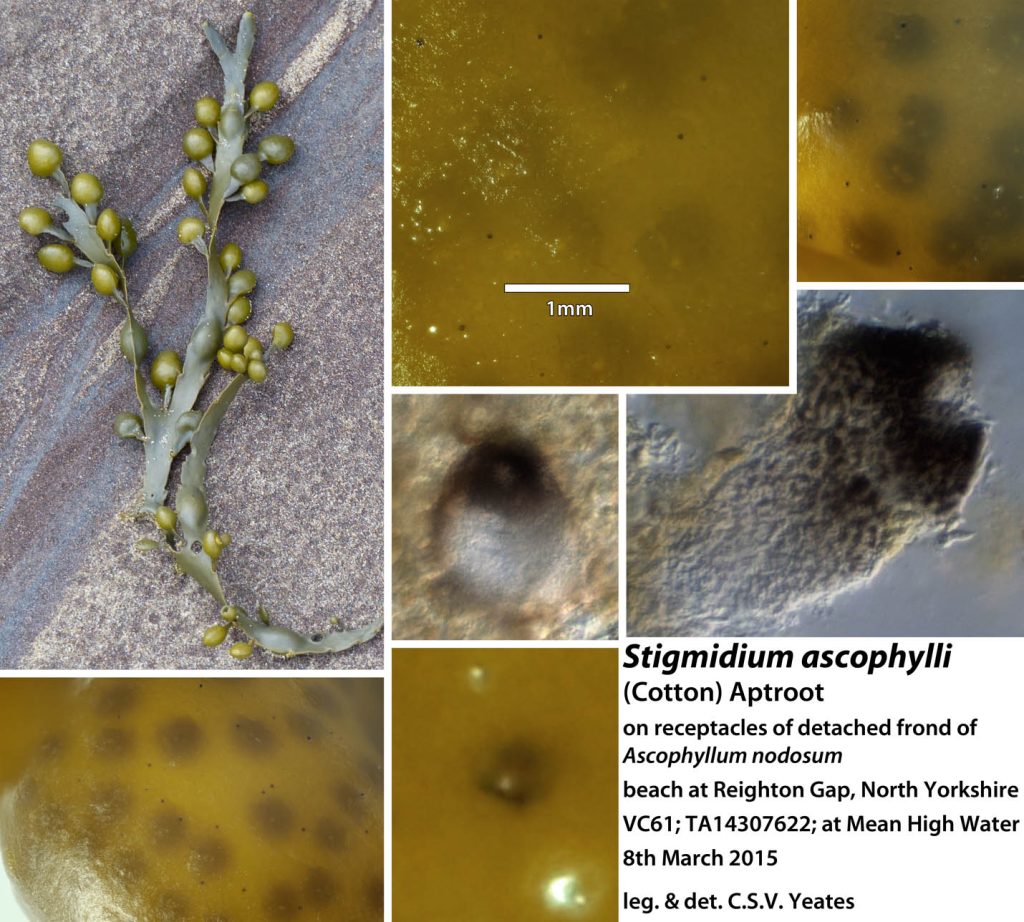
[attachment=0]Stigmidium ascophylli 1.jpg[/attachment] March 18, 2016 at 9:24 am #38202Hi Chris Thanks for posting this interesting subject area. Living so close to the sea, I have spent some time looking at seaweeds and coastal flora but have not been too successful in finding fungi on seaweed; in fact, just two species of plurivorous
Cladosporium. It helps to know what to look for and on what. Not found much literature on seaweed fungi but there is a useful section in
Fungiby Spooner and Roberts. Regards, Chris
March 19, 2016 at 8:33 pm #38203Chris Johnson wrote:Hi Chris . . .
Not found much literature on seaweed fungi but there is a useful section in
Fungiby Spooner and Roberts. Regards, Chris
Hiregarding marine fungi in general – check your email
 March 20, 2016 at 7:46 am #38204
Many thanks, Chris … have replied to your email. April 28, 2016 at 11:30 am #38205Thanks for the info on Marine fungi. Luckily I read it before going on a Seaweed walk with the Aberystwyth Botanical society and Helen Marshall last Sunday.(in Aberystwyth on the rocks next to the pier) Found Stigmidium on every bit of Ascophyllum that I looked at but not on Pelvetia
I’ve attached 2 pics taken with my cheapo digital microscope.
I hope this all works as it’s my first post here.
April 29, 2016 at 6:40 pm #38206gary wrote:Thanks for the info on Marine fungi. Luckily I read it before going on a Seaweed walk with the Aberystwyth Botanical society and Helen Marshall last Sunday.(in Aberystwyth on the rocks next to the pier)
Found Stigmidium on every bit of Ascophyllum that I looked at but not on Pelvetia
I’ve attached 2 pics taken with my cheapo digital microscope.
I hope this all works as it’s my first post here.
Nice onepics are fine; it is truly amazing how this is ever-present on
Ascophyllum– even tar-spot cannot be guaranteed on every sycamore . . . Was Helen M. aware of it? First Cardiganshire records for half a century (those previous again from Aberystwyth. cheers
Chris
May 3, 2016 at 10:55 am #38207Helen M wasn’t aware of it but she is now! I passed the information on to friends around Wales to see if anybody else had come across it .
Now a few more people are looking so it will be interesting to see what turns up. I suspect that the fungus has always been there but nobody’s looked for it.
Arthur sent me some more pictures which I’ve attached, showing asci and ascospores dissected out of the perithecium.
You mention a 50 year old record in Aberystwyth but is there a distribution map on-line anywhere?
May 3, 2016 at 11:38 pm #38208gary wrote:
You mention a 50 year old record in Aberystwyth but is there a distribution map on-line anywhere?
https://data.nbn.org.uk/Taxa/NBNSYS0000016382/Grid_Maphttps://data.nbn.org.uk/Taxa/NBNSYS0000016382/Grid_Map” class=”bbcode_url”> http://www.fieldmycology.net/FRDBI/FRDBIrecord.asp?intGBNum=42505 ” class=”bbcode_url”> http://www.fieldmycology.net/FRDBI/FRDBIrecord.asp?intGBNum=42505 https://data.nbn.org.uk/Taxa/NHMSYS0021058637/Grid_Maphttps://data.nbn.org.uk/Taxa/NHMSYS0021058637/Grid_Map” class=”bbcode_url”> 
best
Chris
May 28, 2016 at 9:52 pm #38209Yes I finally found mature asci and ascospores next time I looked – I suspect there is a narrow window, possibly tying in with the reproductive cycle of the host seaweed.
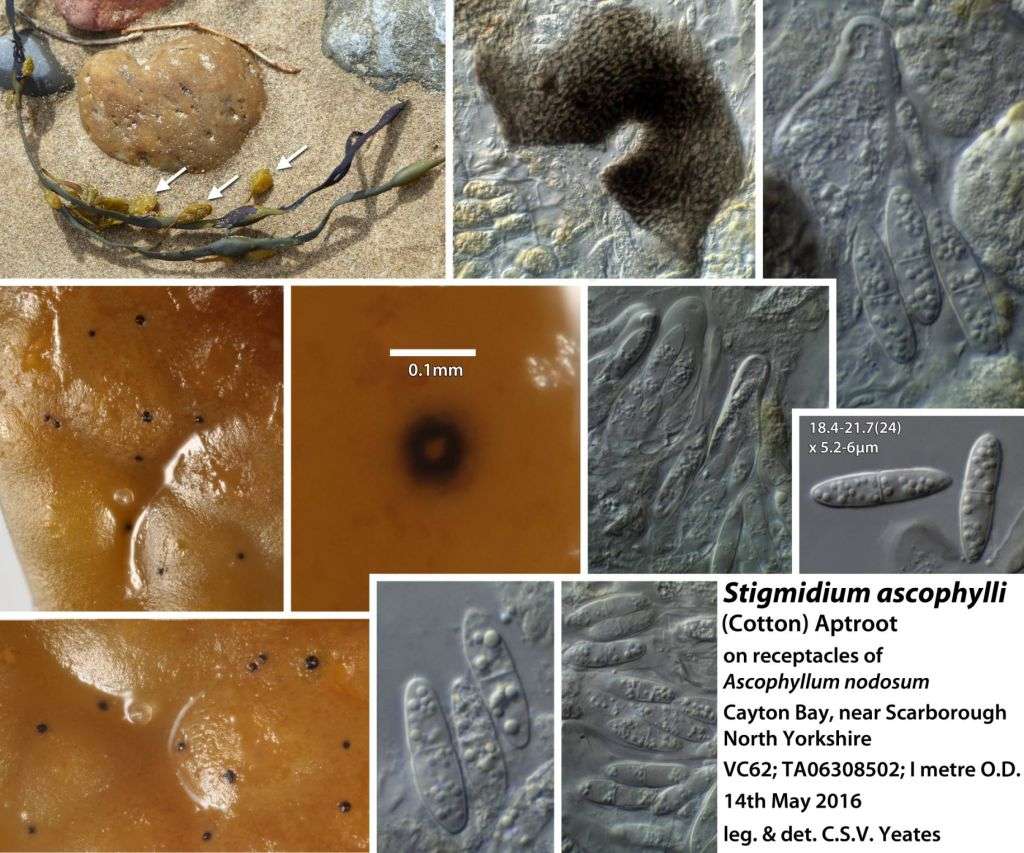
[attachment=0]Stigmidium ascophylli_.jpg[/attachment]
ChrisJune 2, 2016 at 7:35 am #38210I’m sure you’re right about the distribution and that it’s common but under-recorded. I mentioned it to Brian Douglas at Kew ,LAFF and he kindly mentions it (and your thread) in his monthly report.
http://fungi.myspecies.info/content/project-report-march-april-2016 I will try and remember to have a look for it out of season.
June 2, 2016 at 11:50 am #38211Hi Chris and Gary, In case you’re interested, I did get some feedback from a couple of people after mentioning
Stigmidium ascophylliin the Lost and Found Fungi Project update. Malcolm Storey has found it on every bit of piece of
Ascophyllumthat he’s looked at, but hasn’t recorded it. His BioImages record is from Dorset. Paul Gainey went and found it immediately in a couple of places around Cornwall.
I also spotted something which almost certainly was that (macroscopic ID only I’m afraid) near Pembroke while on holiday last month.
I guess the challenge may be to find some
Ascophyllumwhich isn’t infected… Cheers,
Brian
August 17, 2016 at 4:10 pm #38212pyrenopeziza wrote:
I guess the challenge may be to find someAscophyllumwhich isn’t infected… I win the challenge. Since this thread was aired I have looked at dozens of mature specimens of
Ascophyllum nodosumand not until I found myself in a remote bay on Harris, looking for a Lost and Found fungus, did I find a miserable collection. A different story this week. I noticed some maturing
Pelvetia canaliculataand took a closer look. The receptacles were covered in the pseudothecia 
Chris
August 17, 2016 at 7:34 pm #38213Excellent stuff – nice photo’s cheers
Chris
October 2, 2021 at 8:51 am #38214Came across this after thinking about marine fungi again (probably because it’s UK fungus day and raining) https://www.e-algae.org/journal/view.php?number=2438 As always it’s a bit more complicated than it first appears.a 3 way split.
Also I’m wondering how Hormoconis resinae is getting on with this petrol shortage.
Gary
-
AuthorPosts



- You must be logged in to reply to this topic.